Lightning Deaths The graph in Cumulative Review Exercise 5 was created by using data consisting of 242 male deaths from lightning strikes and 64 female deaths from lightning strikes. Assume that these data are randomly selected lightning deaths and proceed to test the claim that the proportion of male deaths is greater than . Use a 0.01 significance level. Any explanation for the result?
Table of contents
- 1. Intro to Stats and Collecting Data1h 14m
- 2. Describing Data with Tables and Graphs1h 55m
- 3. Describing Data Numerically2h 5m
- 4. Probability2h 16m
- 5. Binomial Distribution & Discrete Random Variables3h 6m
- 6. Normal Distribution and Continuous Random Variables2h 11m
- 7. Sampling Distributions & Confidence Intervals: Mean3h 23m
- Sampling Distribution of the Sample Mean and Central Limit Theorem19m
- Distribution of Sample Mean - Excel23m
- Introduction to Confidence Intervals15m
- Confidence Intervals for Population Mean1h 18m
- Determining the Minimum Sample Size Required12m
- Finding Probabilities and T Critical Values - Excel28m
- Confidence Intervals for Population Means - Excel25m
- 8. Sampling Distributions & Confidence Intervals: Proportion1h 25m
- 9. Hypothesis Testing for One Sample3h 29m
- 10. Hypothesis Testing for Two Samples4h 50m
- Two Proportions1h 13m
- Two Proportions Hypothesis Test - Excel28m
- Two Means - Unknown, Unequal Variance1h 3m
- Two Means - Unknown Variances Hypothesis Test - Excel12m
- Two Means - Unknown, Equal Variance15m
- Two Means - Unknown, Equal Variances Hypothesis Test - Excel9m
- Two Means - Known Variance12m
- Two Means - Sigma Known Hypothesis Test - Excel21m
- Two Means - Matched Pairs (Dependent Samples)42m
- Matched Pairs Hypothesis Test - Excel12m
- 11. Correlation1h 24m
- 12. Regression1h 50m
- 13. Chi-Square Tests & Goodness of Fit2h 21m
- 14. ANOVA1h 57m
9. Hypothesis Testing for One Sample
Performing Hypothesis Tests: Proportions
Problem 6.R.11
Textbook Question
Self-InjuryAccording to the article “Self-injurious Behaviors in a College Population,” 17% of undergraduate or graduate students have had at least one incidence of self-injurious behavior. The researchers conducted a survey of 40 college students who reported a history of emotional abuse and found that 12 of them have had at least one incidence of self-injurious behavior. What do the results of this survey tell you about college students who report a history of emotional abuse?
Verified step by step guidance1
Step 1: Identify the population proportion given in the problem. The article states that 17% (or 0.17) of all undergraduate or graduate students have had at least one incidence of self-injurious behavior. This is the baseline proportion for the general college student population.
Step 2: Note the sample data from the survey. Among 40 college students who reported a history of emotional abuse, 12 have had at least one incidence of self-injurious behavior. Calculate the sample proportion \(\hat{p}\) as \(\hat{p} = \frac{12}{40}\).
Step 3: Compare the sample proportion \(\hat{p}\) to the population proportion \(p = 0.17\). This comparison will help determine if students with a history of emotional abuse have a higher incidence of self-injurious behavior than the general student population.
Step 4: To assess whether the difference is statistically significant, consider performing a hypothesis test for a population proportion. Set up the null hypothesis \(H_0: p = 0.17\) (the proportion is the same as the general population) and the alternative hypothesis \(H_a: p > 0.17\) (the proportion is higher for students with emotional abuse history).
Step 5: Calculate the test statistic using the formula for a one-proportion z-test: \(z = \frac{\hat{p} - p}{\sqrt{\frac{p(1-p)}{n}}}\), where \(n=40\) is the sample size. Then, use the z-value to find the p-value and decide whether to reject the null hypothesis, which will tell you if the incidence is significantly higher in this group.
Verified video answer for a similar problem:This video solution was recommended by our tutors as helpful for the problem above
Video duration:
5mPlay a video:
Was this helpful?
Key Concepts
Here are the essential concepts you must grasp in order to answer the question correctly.
Proportion and Percentage
Proportion represents a part of a whole expressed as a fraction or decimal, while percentage is that proportion multiplied by 100. In this question, understanding how to calculate and interpret the proportion of students with self-injurious behavior (e.g., 12 out of 40) is essential to compare it with the general 17% rate.
Recommended video:
Guided course
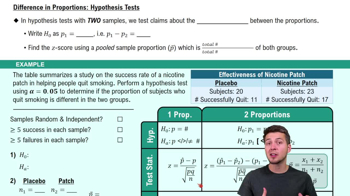
Difference in Proportions: Hypothesis Tests
Comparative Analysis
Comparative analysis involves comparing two or more groups to identify differences or similarities. Here, comparing the 30% (12/40) incidence in students with emotional abuse history to the overall 17% helps assess whether emotional abuse is associated with higher self-injurious behavior.
Recommended video:
Guided course
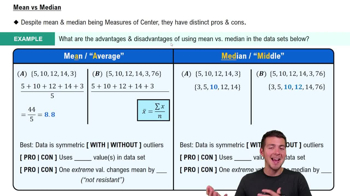
Comparing Mean vs. Median
Sampling and Generalizability
Sampling refers to selecting a subset of individuals from a population to make inferences. Understanding the sample size (40 students) and its representativeness is crucial to evaluate how confidently we can generalize the findings about emotional abuse and self-injury to the broader college population.
Recommended video:
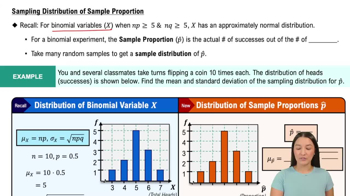
Sampling Distribution of Sample Proportion
Watch next
Master Performing Hypothesis Tests: Proportions with a bite sized video explanation from Patrick
Start learningRelated Videos
Related Practice
Textbook Question
54
views