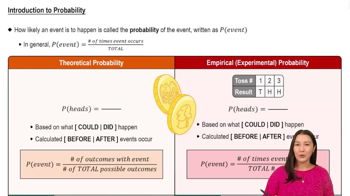
Suppose that you roll a pair of dice 1000 times and get seven 350 times. Based on these results, what is the probability that the next roll results in seven?
Table of contents
- 1. Intro to Stats and Collecting Data1h 14m
- 2. Describing Data with Tables and Graphs1h 55m
- 3. Describing Data Numerically2h 5m
- 4. Probability2h 16m
- 5. Binomial Distribution & Discrete Random Variables3h 6m
- 6. Normal Distribution and Continuous Random Variables2h 11m
- 7. Sampling Distributions & Confidence Intervals: Mean3h 23m
- Sampling Distribution of the Sample Mean and Central Limit Theorem19m
- Distribution of Sample Mean - Excel23m
- Introduction to Confidence Intervals15m
- Confidence Intervals for Population Mean1h 18m
- Determining the Minimum Sample Size Required12m
- Finding Probabilities and T Critical Values - Excel28m
- Confidence Intervals for Population Means - Excel25m
- 8. Sampling Distributions & Confidence Intervals: Proportion1h 25m
- 9. Hypothesis Testing for One Sample3h 29m
- 10. Hypothesis Testing for Two Samples4h 50m
- Two Proportions1h 13m
- Two Proportions Hypothesis Test - Excel28m
- Two Means - Unknown, Unequal Variance1h 3m
- Two Means - Unknown Variances Hypothesis Test - Excel12m
- Two Means - Unknown, Equal Variance15m
- Two Means - Unknown, Equal Variances Hypothesis Test - Excel9m
- Two Means - Known Variance12m
- Two Means - Sigma Known Hypothesis Test - Excel21m
- Two Means - Matched Pairs (Dependent Samples)42m
- Matched Pairs Hypothesis Test - Excel12m
- 11. Correlation1h 24m
- 12. Regression1h 50m
- 13. Chi-Square Tests & Goodness of Fit2h 21m
- 14. ANOVA1h 57m
4. Probability
Basic Concepts of Probability
Problem 5.R.31
Textbook Question
Lottery Luck In 1996, a New York couple won \$2.5 million in the state lottery. Eleven years later, the couple won \$5 million in the state lottery using the same set of numbers. The odds of winning the New York lottery twice are roughly 1 in 16 trillion, described by a lottery spokesperson as “galactically astronomical.” Although it is highly unlikely that an individual will win the lottery twice, it is not “galactically astronomical” that someone will win a lottery twice. Explain why this is the case.
Verified step by step guidance1
Step 1: Understand the difference between the probability of a specific individual winning twice and the probability that someone, among many players, wins twice. The odds of 1 in 16 trillion refer to a particular person winning twice with the same numbers.
Step 2: Recognize that the lottery has millions of players, each with their own chance to win. When considering all players collectively, the chance that at least one person wins twice increases significantly.
Step 3: Use the concept of the 'multiple comparisons' or 'multiple trials' effect, which means that even very rare events become more likely when many independent trials or participants are involved.
Step 4: To quantify this, calculate the probability that no one wins twice by raising the probability of an individual not winning twice to the power of the number of players, then subtract this from 1 to find the probability that at least one person wins twice.
Step 5: Conclude that while the odds for a single individual are astronomically low, the large number of participants makes it not so surprising that someone eventually wins twice, explaining why the event is not 'galactically astronomical' overall.
Verified video answer for a similar problem:This video solution was recommended by our tutors as helpful for the problem above
Video duration:
4mPlay a video:
Was this helpful?
Key Concepts
Here are the essential concepts you must grasp in order to answer the question correctly.
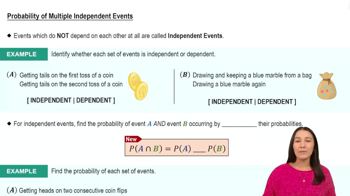
Probability of Independent Events
The probability of two independent events both occurring is the product of their individual probabilities. Winning the lottery twice involves multiplying the already tiny chance of winning once by itself, resulting in an extremely small probability for a specific individual.
Recommended video:
Probability of Multiple Independent Events
Law of Large Numbers and Multiple Trials
When many people play the lottery over many draws, the chance that someone, not a specific person, wins twice increases. Large numbers of trials and participants make rare events more likely to occur somewhere in the population.
Recommended video:
Probability of Multiple Independent Events
Misinterpretation of Probability in Real-World Contexts
People often confuse the improbability of a specific individual winning twice with the likelihood that some individual will win twice. The latter is more probable because it considers all players and all draws, not just one person's odds.
Recommended video:
Introduction to Probability
Watch next
Master Introduction to Probability with a bite sized video explanation from Patrick
Start learningRelated Videos
Related Practice
Textbook Question
4
views