Explain what is meant by a subjective probability. List some examples of subjective probabilities.
Table of contents
- 1. Intro to Stats and Collecting Data1h 14m
- 2. Describing Data with Tables and Graphs1h 55m
- 3. Describing Data Numerically2h 5m
- 4. Probability2h 16m
- 5. Binomial Distribution & Discrete Random Variables3h 6m
- 6. Normal Distribution and Continuous Random Variables2h 11m
- 7. Sampling Distributions & Confidence Intervals: Mean3h 23m
- Sampling Distribution of the Sample Mean and Central Limit Theorem19m
- Distribution of Sample Mean - Excel23m
- Introduction to Confidence Intervals15m
- Confidence Intervals for Population Mean1h 18m
- Determining the Minimum Sample Size Required12m
- Finding Probabilities and T Critical Values - Excel28m
- Confidence Intervals for Population Means - Excel25m
- 8. Sampling Distributions & Confidence Intervals: Proportion1h 25m
- 9. Hypothesis Testing for One Sample3h 29m
- 10. Hypothesis Testing for Two Samples4h 50m
- Two Proportions1h 13m
- Two Proportions Hypothesis Test - Excel28m
- Two Means - Unknown, Unequal Variance1h 3m
- Two Means - Unknown Variances Hypothesis Test - Excel12m
- Two Means - Unknown, Equal Variance15m
- Two Means - Unknown, Equal Variances Hypothesis Test - Excel9m
- Two Means - Known Variance12m
- Two Means - Sigma Known Hypothesis Test - Excel21m
- Two Means - Matched Pairs (Dependent Samples)42m
- Matched Pairs Hypothesis Test - Excel12m
- 11. Correlation1h 24m
- 12. Regression1h 50m
- 13. Chi-Square Tests & Goodness of Fit2h 21m
- 14. ANOVA1h 57m
4. Probability
Basic Concepts of Probability
Problem 5.R.32b
Textbook Question
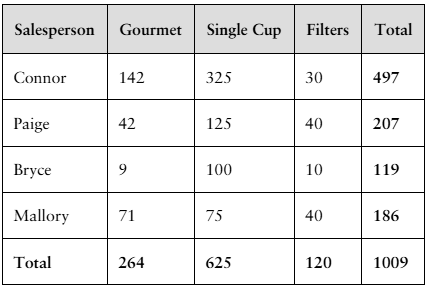
Coffee Sales The following data represent the number of cases of coffee or filters sold by four sales reps in a recent sales competition.
b. What is the probability that a randomly chosen case was Gourmet?

Verified step by step guidance1
Step 1: Understand the problem. We need to find the probability that a randomly chosen case from all the sales is Gourmet coffee.
Step 2: Identify the total number of cases sold. From the table, the total number of cases sold by all salespersons combined is given in the bottom right corner, which is 1009.
Step 3: Identify the total number of Gourmet cases sold. From the table, the total number of Gourmet cases sold is given in the bottom of the Gourmet column, which is 264.
Step 4: Use the probability formula for an event, which is the number of favorable outcomes divided by the total number of outcomes. Here, the favorable outcomes are the Gourmet cases sold.
Step 5: Write the probability expression as \(P(\text{Gourmet}) = \frac{\text{Number of Gourmet cases}}{\text{Total number of cases}} = \frac{264}{1009}\).
Verified video answer for a similar problem:This video solution was recommended by our tutors as helpful for the problem above
Video duration:
2mPlay a video:
Was this helpful?
Key Concepts
Here are the essential concepts you must grasp in order to answer the question correctly.
Probability
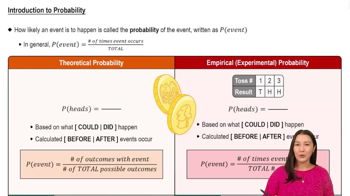
Probability measures the likelihood of an event occurring, expressed as a number between 0 and 1. It is calculated by dividing the number of favorable outcomes by the total number of possible outcomes. In this question, the probability of selecting a Gourmet case is the ratio of Gourmet cases sold to the total cases sold.
Recommended video:
Introduction to Probability
Frequency Distribution
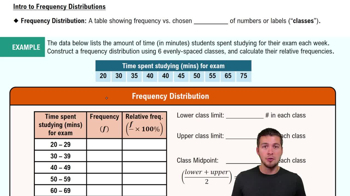
A frequency distribution organizes data into categories showing the number of occurrences in each. Here, the table displays the counts of coffee cases sold by type and salesperson, allowing us to see how many Gourmet cases were sold overall and by each rep, which is essential for calculating probabilities.
Recommended video:
Guided course
Intro to Frequency Distributions
Marginal Totals
Marginal totals are the sums of rows or columns in a contingency table, representing total counts across categories. The total number of cases sold (1009) is a marginal total, used as the denominator when calculating the probability of selecting a Gourmet case from all sales.
Recommended video:
Constructing Confidence Intervals for Proportions
Watch next
Master Introduction to Probability with a bite sized video explanation from Patrick
Start learningRelated Videos
Related Practice
Textbook Question
8
views