Problems 7–12 use the results from Problems 27–32 in Section 4.1 and Problems 17–22 in Section 4.2. a. Find the coefficient of determination, R².
Verified step by step guidance
1
Identify the correlation coefficient, denoted as \(r\), from the given data or previous problems referenced (Problems 27–32 in Section 4.1 and Problems 17–22 in Section 4.2). The correlation coefficient measures the strength and direction of the linear relationship between two variables.
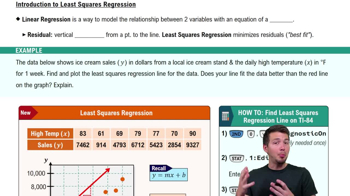
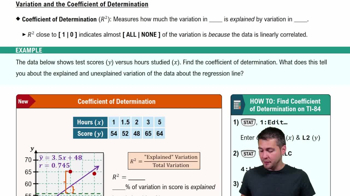
Recall that the coefficient of determination, \(R^{2}\), is the square of the correlation coefficient. It represents the proportion of the variance in the dependent variable that is predictable from the independent variable.
Write the formula for the coefficient of determination:
\[R^{2} = r^{2}\]
Square the value of the correlation coefficient \(r\) to calculate \(R^{2}\). This involves multiplying \(r\) by itself.
Interpret the result: \(R^{2}\) ranges from 0 to 1, where values closer to 1 indicate a stronger linear relationship and better explanatory power of the regression model.
Verified video answer for a similar problem:
This video solution was recommended by our tutors as helpful for the problem above
Video duration:
2m
Play a video:
0 Comments
Key Concepts
Here are the essential concepts you must grasp in order to answer the question correctly.
Coefficient of Determination (R²)
R² measures the proportion of variance in the dependent variable explained by the independent variable(s) in a regression model. It ranges from 0 to 1, where higher values indicate a better fit. R² helps assess how well the model explains the data.
Regression analysis estimates the relationship between dependent and independent variables. It provides coefficients that describe this relationship, which are essential for calculating R². Understanding regression output is key to interpreting model fit.
Sum of squares quantify variation in data: Total SS measures overall variance, Regression SS measures explained variance, and Residual SS measures unexplained variance. R² is calculated as Regression SS divided by Total SS, linking these concepts directly.