
Ch. 5 - Discrete Probability Distributions
Triola - Elementary Statistics 14th Edition
Triola14th EditionElementary StatisticsISBN: 9780137366446Not the one you use?Change textbook
Chapter 5, Problem 5.Q.4

Find the mean of the random variable x described in the preceding exercise.

Verified step by step guidance
1
Step 1: Recall the formula for the mean (expected value) of a random variable x. The mean is calculated as \( \mu = \sum_{i} x_i P(x_i) \), where \( x_i \) represents the values of the random variable and \( P(x_i) \) represents their corresponding probabilities.
Step 2: Identify the values of \( x_i \) (the possible outcomes of the random variable) and \( P(x_i) \) (the probabilities associated with each outcome) from the preceding exercise.
Step 3: Multiply each value \( x_i \) by its corresponding probability \( P(x_i) \). This gives the weighted contribution of each outcome to the mean.
Step 4: Sum all the weighted contributions \( \sum_{i} x_i P(x_i) \) to compute the mean of the random variable.
Step 5: Ensure that the probabilities \( P(x_i) \) sum to 1, as this is a requirement for a valid probability distribution. If they do not, revisit the preceding exercise to verify the probabilities.

Verified video answer for a similar problem:

This video solution was recommended by our tutors as helpful for the problem above.
Video duration:
2m
Was this helpful?

Key Concepts

Here are the essential concepts you must grasp in order to answer the question correctly.

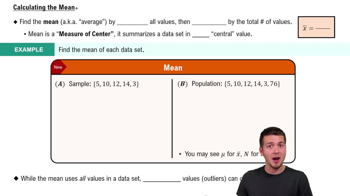
Mean

The mean, often referred to as the average, is a measure of central tendency that summarizes a set of values by dividing the sum of all values by the number of values. In the context of a random variable, the mean represents the expected value, indicating where the center of the distribution lies. It is a crucial concept in statistics as it provides a single value that represents the entire dataset.
Recommended video:
Guided course
04:52
Calculating the Mean

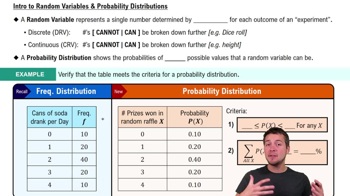
Random Variable

A random variable is a numerical outcome of a random phenomenon, which can take on different values based on the outcome of a random event. Random variables can be discrete, taking on specific values, or continuous, taking on any value within a range. Understanding random variables is essential for calculating probabilities and statistical measures like the mean.
Recommended video:
Guided course
07:09
Intro to Random Variables & Probability Distributions

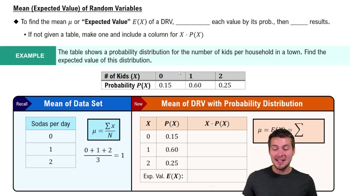
Expected Value

The expected value of a random variable is a fundamental concept in probability and statistics that represents the long-term average of the variable's outcomes. It is calculated by multiplying each possible outcome by its probability and summing these products. The expected value provides insight into the average result one can anticipate from a random variable over numerous trials.
Recommended video:
Guided course
04:14
Expected Value (Mean) of Random Variables
Related Practice
Textbook Question

Kentucky Pick 4 In the Kentucky Pick 4 lottery game, you can pay \$1 for a “straight” bet in which you select four digits with repetition allowed. If you buy only one ticket and win, your prize is \$2500.


c. If you play this game once every day, find the probability of no wins in 365 days.

92
views
Textbook Question

Kentucky Pick 4 In the Kentucky Pick 4 lottery game, you can pay \$1 for a “straight” bet in which you select four digits with repetition allowed. If you buy only one ticket and win, your prize is \$2500.


a. If you buy one ticket, what is the probability of winning?

121
views
Textbook Question

In Exercises 1–5, assume that 4.2% of workers test positive when tested for illegal drugs (based on data from Quest Diagnostics). Assume that a group of ten workers is randomly selected.


Workplace Drug Testing Find the probability that exactly two of the ten workers test positive for illegal drugs.

164
views
Textbook Question

Is the mean found in the preceding exercise a statistic or a parameter?

132
views
Textbook Question

Tennis Challenge In a recent U.S. Open tennis tournament, there were 945 challenges made by singles players, and 255 of them resulted in referee calls that were overturned. The accompanying table lists the results by gender.


b. If one of the overturned calls is randomly selected, what is the probability that the challenge was made by a woman?

83
views
Textbook Question

In Exercises 6–10, refer to the accompanying table, which describes the numbers of adults in groups of five who reported sleepwalking (based on data from “Prevalence and Comorbidity of Nocturnal Wandering In the U.S. Adult General Population,” by Ohayon et al., Neurology, Vol. 78, No. 20).

Significant Events Is 4 a significantly high number of sleepwalkers in a group of 5 adults? Explain.

110
views