Ch. 4 - Discrete Probability Distributions
Larson - Elementary Statistics: Picturing the World 8th Edition
Larson8th EditionElementary Statistics: Picturing the WorldISBN: 9780137493470Not the one you use?Change textbook
Chapter 4, Problem 4.3.18a

Using a Distribution to Find Probabilities In Exercises 11–26, find the indicated probabilities using the geometric distribution, the Poisson distribution, or the binomial distribution. Then determine whether the events are unusual. If convenient, use a table or technology to find the probabilities.


Living Donor Transplants The mean number of organ transplants from living donors performed per day in the United States in 2020 was about 16. Find the probability that the number of organ transplants from living donors performed on any given day is (a) exactly 12 (Source: Organ Procurement and Transplantation Network)

Verified step by step guidance
1
Step 1: Identify the type of distribution to use. Since the problem involves the mean number of events (16 transplants per day) and asks for the probability of a specific number of events (exactly 12 transplants), this is a Poisson distribution problem. The Poisson distribution is used to model the probability of a given number of events occurring in a fixed interval of time or space when the events occur independently and at a constant average rate.
Step 2: Write down the formula for the Poisson probability distribution. The probability of observing exactly k events is given by: P(X = k) = (λ^k * e^(-λ)) / k!, where λ is the mean number of events, k is the specific number of events, and e is the base of the natural logarithm (approximately 2.718).
Step 3: Substitute the given values into the formula. Here, λ = 16 (mean number of transplants per day) and k = 12 (specific number of transplants). The formula becomes: P(X = 12) = (16^12 * e^(-16)) / 12!.
Step 4: Simplify the expression. Calculate the numerator (16^12 * e^(-16)) and the denominator (12!). If using technology or a statistical calculator, input these values directly to find the probability. Alternatively, use a Poisson probability table or software to find P(X = 12) for λ = 16.
Step 5: Determine whether the event is unusual. An event is typically considered unusual if its probability is less than 0.05. Compare the calculated probability to this threshold to decide if observing exactly 12 transplants in a day is unusual.

Verified video answer for a similar problem:

This video solution was recommended by our tutors as helpful for the problem above.
Video duration:
1m
Was this helpful?

Key Concepts

Here are the essential concepts you must grasp in order to answer the question correctly.

Geometric Distribution

The geometric distribution models the number of trials needed to achieve the first success in a series of independent Bernoulli trials. It is characterized by a constant probability of success on each trial. This distribution is useful for scenarios where we are interested in the number of attempts until a specific event occurs, such as finding the first successful organ transplant.
Recommended video:
Guided course
06:38
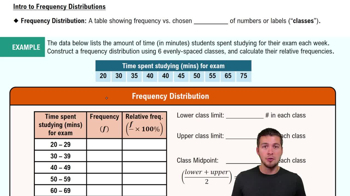
Intro to Frequency Distributions

Poisson Distribution

The Poisson distribution is used to model the number of events occurring within a fixed interval of time or space, given a known average rate of occurrence. It is particularly applicable for rare events, such as organ transplants, where the events are independent. The mean of the distribution represents the average number of occurrences, making it suitable for calculating probabilities in this context.
Recommended video:
Guided course
06:38
Intro to Frequency Distributions

Binomial Distribution

The binomial distribution describes the number of successes in a fixed number of independent Bernoulli trials, each with the same probability of success. It is defined by two parameters: the number of trials and the probability of success. This distribution is relevant when assessing the likelihood of a certain number of successes, such as the number of organ transplants performed in a day, given a specific probability.
Recommended video:
Guided course
03:28
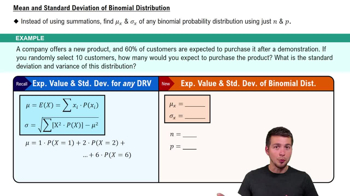
Mean & Standard Deviation of Binomial Distribution
Related Practice
Textbook Question

Manufacturing An assembly line produces 10,000 automobile parts. Twenty percent of the parts are defective. An inspector randomly selects 10 of the parts


a. Use the Multiplication Rule (discussed in Section 3.2) to find the probability that none of the selected parts are defective. (Note that the events are dependent.)

84
views
Textbook Question

Finding Probabilities Use the probability distribution you made in Exercise 19 to find the probability of randomly selecting a household that has (b) two or more HD televisions

69
views
Textbook Question

Hypergeometric Distribution Binomial experiments require that any sampling be done with replacement because each trial must be independent of the others. The hypergeometric distribution also has two outcomes: success and failure. The sampling, however, is done without replacement. For a population of N items having k successes and failures, the probability of selecting a sample of size that has successes and failures is given by

" style="" width="245">

In a shipment of 15 microchips, 2 are defective and 13 are not defective. A sample of three microchips is chosen at random. Use the above formula to find the probability that (a) all three microchips are not defective

218
views
Textbook Question

Unusual Events In Exercises 37 and 38, find the indicated probabilities. Then determine if the event is unusual. Explain your reasoning.


Rock-Paper-Scissors The probability of winning a game of rock-paper-scissors is 1/3. You play nine games of rock-paper-scissors. Find the probability that the number of games you win is (b) more than five

95
views
Textbook Question

Unusual Events In Exercises 37 and 38, find the indicated probabilities. Then determine if the event is unusual. Explain your reasoning.


Rock-Paper-Scissors The probability of winning a game of rock-paper-scissors is 1/3. You play nine games of rock-paper-scissors. Find the probability that the number of games you win is (a) exactly five

106
views
Textbook Question

Hypergeometric Distribution Binomial experiments require that any sampling be done with replacement because each trial must be independent of the others. The hypergeometric distribution also has two outcomes: success and failure. The sampling, however, is done without replacement. For a population of N items having k successes and failures, the probability of selecting a sample of size that has successes and failures is given by

" style="max-width: 100%; white-space-collapse: preserve;" width="245">


In a shipment of 15 microchips, 2 are defective and 13 are not defective. A sample of three microchips is chosen at random. Use the above formula to find the probability that (b) one microchip is defective and two are not defective

138
views