
Birth Weights The table below lists some of the same data used in the preceding exercise, but the seven days of the week are combined into weekday (Monday, Tuesday, Wednesday, Thursday, Friday) and weekend days (Saturday, Sunday). Also, the birth weights are converted to kilograms. What do you conclude?
Table of contents
- 1. Intro to Stats and Collecting Data1h 14m
- 2. Describing Data with Tables and Graphs1h 55m
- 3. Describing Data Numerically2h 5m
- 4. Probability2h 16m
- 5. Binomial Distribution & Discrete Random Variables3h 6m
- 6. Normal Distribution and Continuous Random Variables2h 11m
- 7. Sampling Distributions & Confidence Intervals: Mean3h 23m
- Sampling Distribution of the Sample Mean and Central Limit Theorem19m
- Distribution of Sample Mean - Excel23m
- Introduction to Confidence Intervals15m
- Confidence Intervals for Population Mean1h 18m
- Determining the Minimum Sample Size Required12m
- Finding Probabilities and T Critical Values - Excel28m
- Confidence Intervals for Population Means - Excel25m
- 8. Sampling Distributions & Confidence Intervals: Proportion1h 25m
- 9. Hypothesis Testing for One Sample3h 29m
- 10. Hypothesis Testing for Two Samples4h 50m
- Two Proportions1h 13m
- Two Proportions Hypothesis Test - Excel28m
- Two Means - Unknown, Unequal Variance1h 3m
- Two Means - Unknown Variances Hypothesis Test - Excel12m
- Two Means - Unknown, Equal Variance15m
- Two Means - Unknown, Equal Variances Hypothesis Test - Excel9m
- Two Means - Known Variance12m
- Two Means - Sigma Known Hypothesis Test - Excel21m
- Two Means - Matched Pairs (Dependent Samples)42m
- Matched Pairs Hypothesis Test - Excel12m
- 11. Correlation1h 24m
- 12. Regression1h 50m
- 13. Chi-Square Tests & Goodness of Fit2h 21m
- 14. ANOVA1h 57m
3. Describing Data Numerically
Mean
Problem 2.3.48
Textbook Question
Grades In Exercise 46, one of the student’s B grades gets changed to an A. What is the student’s new grade point average?
Verified step by step guidance1
Identify the grading scale used to calculate the grade point average (GPA). For example, A = 4.0, B = 3.0, C = 2.0, etc. Confirm the weights assigned to each grade.
Determine the total number of grades the student has, including the original B grade that is being changed to an A.
Calculate the total grade points before the change. Multiply the number of each grade by its corresponding grade point value and sum them up.
Adjust the total grade points by replacing one B grade (3.0) with an A grade (4.0). Subtract the grade points for the B and add the grade points for the A.
Divide the updated total grade points by the total number of grades to compute the new GPA. Use the formula: GPA = (Total Grade Points) / (Total Number of Grades).
Verified video answer for a similar problem:This video solution was recommended by our tutors as helpful for the problem above
Video duration:
2mPlay a video:
Was this helpful?
Key Concepts
Here are the essential concepts you must grasp in order to answer the question correctly.
Grade Point Average (GPA)
Grade Point Average (GPA) is a numerical representation of a student's academic performance, calculated by assigning a point value to each grade and averaging these values. Typically, an A is worth 4.0 points, a B is worth 3.0 points, and other grades have corresponding values. The GPA is calculated by dividing the total grade points earned by the total number of credit hours attempted.
Recommended video:
Guided course
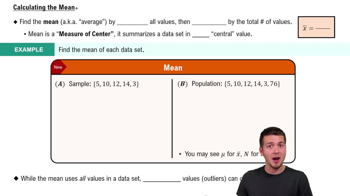
Calculating the Mean
Impact of Grade Change
Changing a grade from B to A affects the overall GPA by increasing the total grade points earned. This change alters the numerator in the GPA calculation, potentially raising the average if the course has a significant weight in the total credit hours. Understanding how each grade contributes to the GPA is crucial for accurately determining the new average after a grade change.
Recommended video:
Permutations vs. Combinations
Weighted vs. Unweighted GPA
GPA can be calculated as either weighted or unweighted. An unweighted GPA treats all courses equally, while a weighted GPA gives additional points for advanced courses (like honors or AP classes). Knowing whether the GPA in question is weighted or unweighted is essential for accurately calculating the new average after a grade change, as it influences the overall point distribution.
Recommended video:
Guided course
Visualizing Qualitative vs. Quantitative Data
Watch next
Master Calculating the Mean with a bite sized video explanation from Patrick
Start learningRelated Videos
Related Practice
Textbook Question
60
views
