
Grades In Exercise 46, one of the student’s B grades gets changed to an A. What is the student’s new grade point average?
Table of contents
- 1. Intro to Stats and Collecting Data1h 14m
- 2. Describing Data with Tables and Graphs1h 55m
- 3. Describing Data Numerically2h 5m
- 4. Probability2h 16m
- 5. Binomial Distribution & Discrete Random Variables3h 6m
- 6. Normal Distribution and Continuous Random Variables2h 11m
- 7. Sampling Distributions & Confidence Intervals: Mean3h 23m
- Sampling Distribution of the Sample Mean and Central Limit Theorem19m
- Distribution of Sample Mean - Excel23m
- Introduction to Confidence Intervals15m
- Confidence Intervals for Population Mean1h 18m
- Determining the Minimum Sample Size Required12m
- Finding Probabilities and T Critical Values - Excel28m
- Confidence Intervals for Population Means - Excel25m
- 8. Sampling Distributions & Confidence Intervals: Proportion1h 25m
- 9. Hypothesis Testing for One Sample3h 29m
- 10. Hypothesis Testing for Two Samples4h 50m
- Two Proportions1h 13m
- Two Proportions Hypothesis Test - Excel28m
- Two Means - Unknown, Unequal Variance1h 3m
- Two Means - Unknown Variances Hypothesis Test - Excel12m
- Two Means - Unknown, Equal Variance15m
- Two Means - Unknown, Equal Variances Hypothesis Test - Excel9m
- Two Means - Known Variance12m
- Two Means - Sigma Known Hypothesis Test - Excel21m
- Two Means - Matched Pairs (Dependent Samples)42m
- Matched Pairs Hypothesis Test - Excel12m
- 11. Correlation1h 24m
- 12. Regression1h 50m
- 13. Chi-Square Tests & Goodness of Fit2h 21m
- 14. ANOVA1h 57m
3. Describing Data Numerically
Mean
Problem 2.3.66c
Textbook Question
Extending Concepts
Trimmed Mean To find the 10% trimmed mean of a data set, order the data, delete the lowest 10% of the entries and the highest 10% of the entries, and find the mean of the remaining entries.
c. What is the benefit of using a trimmed mean versus using a mean found using all data entries? Explain your reasoning.
Verified step by step guidance1
Step 1: Understand the concept of a trimmed mean. A trimmed mean is a measure of central tendency that removes a specified percentage of the smallest and largest data points before calculating the mean. This helps reduce the influence of outliers.
Step 2: The benefit of using a trimmed mean is that it provides a more robust measure of central tendency, especially when the data set contains extreme values (outliers) that could skew the mean calculated using all data entries.
Step 3: By removing the lowest 10% and highest 10% of the data, the trimmed mean focuses on the central portion of the data, which is often more representative of the typical values in the data set.
Step 4: Using a trimmed mean can improve the accuracy of statistical analysis in cases where the data distribution is not symmetric or contains anomalies, as it reduces the impact of extreme values.
Step 5: In summary, the trimmed mean is beneficial because it provides a more reliable and less sensitive measure of central tendency in the presence of outliers or non-normal data distributions.
Verified video answer for a similar problem:This video solution was recommended by our tutors as helpful for the problem above
Video duration:
2mPlay a video:
Was this helpful?
Key Concepts
Here are the essential concepts you must grasp in order to answer the question correctly.
Trimmed Mean
A trimmed mean is a statistical measure that involves removing a specified percentage of the lowest and highest values from a data set before calculating the mean. This approach helps to reduce the influence of outliers or extreme values, providing a more robust central tendency measure that better represents the majority of the data.
Recommended video:
Guided course
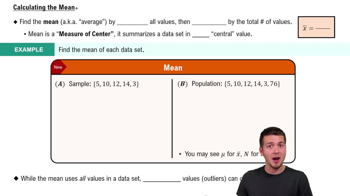
Calculating the Mean
Outliers
Outliers are data points that significantly differ from other observations in a data set. They can skew the results of statistical analyses, particularly measures like the mean, leading to misleading conclusions. By using a trimmed mean, the impact of these outliers is minimized, resulting in a more accurate reflection of the data's overall trend.
Recommended video:
Guided course
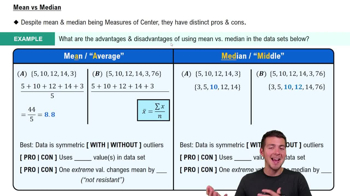
Comparing Mean vs. Median
Robust Statistics
Robust statistics are methods that provide reliable results even when assumptions about the data are violated, such as the presence of outliers. The trimmed mean is an example of a robust statistic, as it focuses on the central portion of the data, making it less sensitive to extreme values and thus offering a more stable measure of central tendency.
Recommended video:
Guided course
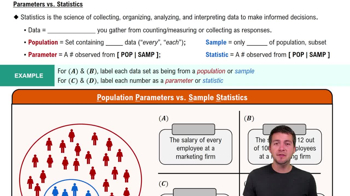
Parameters vs. Statistics
Watch next
Master Calculating the Mean with a bite sized video explanation from Patrick
Start learningRelated Videos
Related Practice
Textbook Question
53
views
