
Ch. 1 - Introduction to Statistics
Triola - Elementary Statistics 14th Edition
Triola14th EditionElementary StatisticsISBN: 9780137366446Not the one you use?Change textbook
Chapter 1, Problem 1.1.19

In Exercises 13–20, determine whether the results appear to have statistical significance, and also determine whether the results appear to have practical significance.


Bias in Jury Selection In the case of Casteneda v. Partida, it was found that during a period of 11 years in Hidalgo County, Texas, 870 people were selected for grand jury duty, and 39% of them were Americans of Mexican ancestry. Among the people eligible for grand jury duty, 79.1% were Americans of Mexican ancestry.

Verified step by step guidance
1
Identify the null hypothesis (H0) and the alternative hypothesis (H1). In this case, H0: The proportion of Americans of Mexican ancestry selected for jury duty is equal to the proportion eligible (p = 0.791). H1: The proportion of Americans of Mexican ancestry selected for jury duty is not equal to the proportion eligible (p ≠ 0.791).
Calculate the sample proportion (p̂) of Americans of Mexican ancestry selected for jury duty. This is given as 39%, or 0.39.
Determine the sample size (n), which is the total number of people selected for jury duty. In this case, n = 870.
Use the formula for the standard error of the sample proportion: SE = sqrt((p * (1 - p)) / n), where p is the population proportion (0.791) and n is the sample size (870).
Calculate the z-score using the formula: z = (p̂ - p) / SE, where p̂ is the sample proportion (0.39), p is the population proportion (0.791), and SE is the standard error calculated in the previous step. Compare the z-score to a critical value from the standard normal distribution to determine statistical significance. Consider practical significance by evaluating the real-world impact of the difference in proportions.

Verified video answer for a similar problem:

This video solution was recommended by our tutors as helpful for the problem above.
Video duration:
3m
Was this helpful?

Key Concepts

Here are the essential concepts you must grasp in order to answer the question correctly.

Statistical Significance

Statistical significance refers to the likelihood that a result or relationship is caused by something other than mere random chance. In the context of jury selection, it involves determining if the observed proportion of Americans of Mexican ancestry selected for jury duty significantly deviates from the expected proportion based on the eligible population. This is typically assessed using hypothesis testing and p-values.
Recommended video:
Guided course
06:34
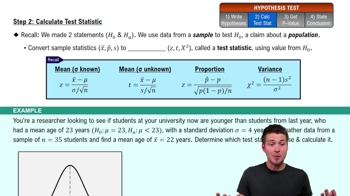
Step 2: Calculate Test Statistic

Practical Significance

Practical significance considers whether a statistically significant result has real-world implications or importance. Even if a result is statistically significant, it may not be practically significant if the effect size is too small to matter in a real-world context. In the jury selection case, practical significance would assess whether the difference in proportions has meaningful consequences for the fairness of the jury selection process.
Recommended video:
Guided course
04:46
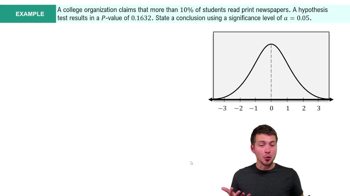
Step 4: State Conclusion Example 4

Bias in Jury Selection

Bias in jury selection refers to systematic favoritism or discrimination in the process of selecting jurors, which can lead to unrepresentative juries. In Casteneda v. Partida, the potential bias is evaluated by comparing the proportion of Americans of Mexican ancestry selected for jury duty to the proportion eligible, highlighting discrepancies that may indicate discriminatory practices. Understanding bias is crucial for ensuring equitable legal proceedings.
Recommended video:
04:06
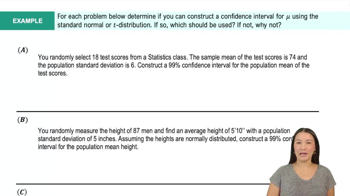
Critical Values: t-Distribution Example 1
Related Practice
Textbook Question

In Exercises 21–28, determine whether the study is an experiment or an observational study, and then identify a major problem with the study.

Sleep Study When designing the study of a new treatment for insomnia in adults, researchers were criticized because their test subjects consisted of 75 college students. They then expanded the study so that 750 college students were given the treatment.

310
views
Textbook Question

In Exercises 37–44, answer the given questions, which are related to percentages.

Percentages in Advertising An ad for Big Skinny wallets included the statement that one of their wallets “reduces your filled wallet size by 50%–200%.” What is wrong with this statement?

267
views
Textbook Question

In Exercises 9–20, identify which of these types of sampling is used: random, systematic, convenience, stratified, or cluster.

Cormorant Density Cormorant bird population densities were studied by using the “line transect method” with aircraft observers flying along the shoreline of Lake Huron and collecting sample data at intervals of every 20 km (based on data from Journal of Great Lakes Research).

343
views
Textbook Question

In Exercises 21–28, determine which of the four levels of measurement (nominal, ordinal, interval, ratio) best describes the given data.

Areas of States A data set consists of the areas of each of the 50 United States.

291
views
Textbook Question

In Exercises 29–36, identify what is wrong.

Healthy Water In a USA Today online poll, 951 Internet users chose to respond, and 57% of them said that they prefer drinking bottled water instead of tap water.

279
views
Textbook Question

In Exercises 21–28, determine which of the four levels of measurement (nominal, ordinal, interval, ratio) best describes the given data.

Criminology In a criminology study, the lengths of prison sentences are obtained for randomly selected subjects convicted of auto theft.

371
views