
Ch. 2 - Exploring Data with Tables and Graphs
Triola - Elementary Statistics 14th Edition
Triola14th EditionElementary StatisticsISBN: 9780137366446Not the one you use?Change textbook
Chapter 2, Problem 2.CRE.4a

In Exercises 1–5, use the data listed in the margin, which are magnitudes (Richter scale) and depths (km) of earthquakes from Data Set 24 “Earthquakes” in Appendix B
[Image]
Data Type


a. The listed earthquake depths (km) are all rounded to one decimal place. Before rounding, are the exact depths discrete data or continuous data?

Verified step by step guidance
1
Understand the difference between discrete and continuous data: Discrete data consists of distinct, separate values (e.g., counts like 1, 2, 3), while continuous data can take any value within a range (e.g., measurements like 1.1, 1.2, 1.3).
Examine the context of the problem: Earthquake depths are measured in kilometers and rounded to one decimal place. This suggests that the original data is based on measurements.
Recognize that measurements, such as depth, are typically continuous because they can take any value within a range, even if they are later rounded.
Consider the rounding process: Rounding does not change the nature of the original data. Even though the depths are rounded to one decimal place, the exact (pre-rounded) depths could still take any value within a range.
Conclude that the exact (pre-rounded) earthquake depths are continuous data because they represent measurements that can take any value within a range, not distinct, separate values.

Verified video answer for a similar problem:

This video solution was recommended by our tutors as helpful for the problem above.
Video duration:
1m
Was this helpful?

Key Concepts

Here are the essential concepts you must grasp in order to answer the question correctly.

Discrete vs. Continuous Data

Discrete data consists of distinct, separate values, often counted in whole numbers, such as the number of students in a class. In contrast, continuous data can take any value within a given range and is often measured, such as the depth of an earthquake, which can include fractions and decimals.
Recommended video:
Guided course
04:39
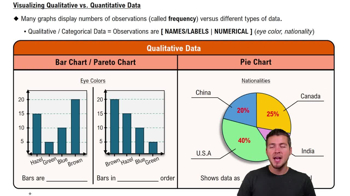
Visualizing Qualitative vs. Quantitative Data

Measurement Scales

Measurement scales categorize data into different types, including nominal, ordinal, interval, and ratio scales. Earthquake depths are typically measured on a ratio scale, which has a true zero point and allows for meaningful comparisons and calculations, such as determining how much deeper one earthquake is than another.
Recommended video:
04:13
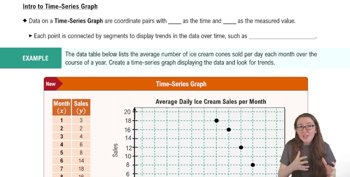
Creating Time-Series Graphs

Rounding in Data

Rounding is the process of reducing the number of digits in a number while maintaining its value as close as possible to the original. When data is rounded, it can affect the classification of the data type; however, the underlying nature of the data (discrete or continuous) remains unchanged, as it is based on the original measurements before rounding.
Recommended video:
Guided course
04:39
Visualizing Qualitative vs. Quantitative Data
Related Practice
Textbook Question

It’s Like Time to Do This Exercise In a Marist survey of adults, these are the words or phrases that subjects find most annoying in conversation (along with their frequencies of response): like (127); just sayin’ (81); you know (104); whatever (219); obviously (35). Construct a pie chart. Identify one disadvantage of a pie chart.

147
views
Textbook Question

Whatever Use the same data from Exercise 7 to construct a Pareto chart. Which graph does a better job of illustrating the data: Pareto chart or pie chart?

170
views
Textbook Question

In Exercises 1–5, use the data listed in the margin, which are magnitudes (Richter scale) and depths (km) of earthquakes from Data Set 24 “Earthquakes” in Appendix B

[Image]

Data Type


b. For the listed earthquake depths, are the data categorical or quantitative?

246
views
Textbook Question

Environment


a. After collecting the average (mean) global temperatures for each of the most recent 100 years, we want to construct the graph that is most appropriate for these data. Which graph is best?

89
views
Textbook Question

In Exercises 1–5, use the data listed in the margin, which are magnitudes (Richter scale) and depths (km) of earthquakes from Data Set 24 “Earthquakes” in Appendix B

[Image]

Data Type


c. Identify the level of measurement of the listed earthquake depths: nominal, ordinal, interval, or ratio.

213
views
Textbook Question

In Exercises 1–5, use the data listed in the margin, which are magnitudes (Richter scale) and depths (km) of earthquakes from Data Set 24 “Earthquakes” in Appendix B

[Image]

Data Type


d. Given that the listed earthquake depths are part of a larger collection of depths, do the data constitute a sample or a population?

172
views