Boxplot Using the same differences from Exercise 1, construct a boxplot and include the values of the 5-number summary.
Table of contents
- 1. Intro to Stats and Collecting Data1h 14m
- 2. Describing Data with Tables and Graphs1h 55m
- 3. Describing Data Numerically2h 5m
- 4. Probability2h 16m
- 5. Binomial Distribution & Discrete Random Variables3h 6m
- 6. Normal Distribution and Continuous Random Variables2h 11m
- 7. Sampling Distributions & Confidence Intervals: Mean3h 23m
- Sampling Distribution of the Sample Mean and Central Limit Theorem19m
- Distribution of Sample Mean - Excel23m
- Introduction to Confidence Intervals15m
- Confidence Intervals for Population Mean1h 18m
- Determining the Minimum Sample Size Required12m
- Finding Probabilities and T Critical Values - Excel28m
- Confidence Intervals for Population Means - Excel25m
- 8. Sampling Distributions & Confidence Intervals: Proportion1h 25m
- 9. Hypothesis Testing for One Sample3h 29m
- 10. Hypothesis Testing for Two Samples4h 50m
- Two Proportions1h 13m
- Two Proportions Hypothesis Test - Excel28m
- Two Means - Unknown, Unequal Variance1h 3m
- Two Means - Unknown Variances Hypothesis Test - Excel12m
- Two Means - Unknown, Equal Variance15m
- Two Means - Unknown, Equal Variances Hypothesis Test - Excel9m
- Two Means - Known Variance12m
- Two Means - Sigma Known Hypothesis Test - Excel21m
- Two Means - Matched Pairs (Dependent Samples)42m
- Matched Pairs Hypothesis Test - Excel12m
- 11. Correlation1h 24m
- 12. Regression1h 50m
- 13. Chi-Square Tests & Goodness of Fit2h 21m
- 14. ANOVA1h 57m
3. Describing Data Numerically
Describing Data Numerically Using a Graphing Calculator
Problem 10.1.10d
Textbook Question
Clusters Refer to the Minitab-generated scatterplot. The four points in the lower left corner are measurements from women, and the four points in the upper right corner are from men.

Find the value of the linear correlation coefficient using all eight points. What does that value suggest about the relationship between x and y?
Verified step by step guidance1
Step 1: Understand the problem. The scatterplot shows two distinct clusters of points: one in the lower left corner (representing measurements from women) and one in the upper right corner (representing measurements from men). The task is to calculate the linear correlation coefficient (r) for all eight points and interpret its meaning.
Step 2: Recall the formula for the linear correlation coefficient (r): r = (Σ((x_i - x̄)(y_i - ȳ))) / sqrt(Σ(x_i - x̄)^2 * Σ(y_i - ȳ)^2). Here, x̄ and ȳ are the means of the x and y values, respectively, and x_i and y_i are the individual data points.
Step 3: Calculate the mean of the x-values (x̄) and the mean of the y-values (ȳ). To do this, sum all x-values and divide by the number of points (8), and repeat the process for the y-values.
Step 4: Compute the deviations from the mean for each x and y value (x_i - x̄ and y_i - ȳ). Then, calculate the product of these deviations for each point and sum them to find Σ((x_i - x̄)(y_i - ȳ)).
Step 5: Calculate the squared deviations for x and y (Σ(x_i - x̄)^2 and Σ(y_i - ȳ)^2). Use these values to compute the denominator of the formula. Finally, divide the numerator by the denominator to find the correlation coefficient (r). Interpret the result: if r is close to 0, it suggests no linear relationship; if r is close to 1 or -1, it suggests a strong positive or negative linear relationship, respectively.
Verified video answer for a similar problem:This video solution was recommended by our tutors as helpful for the problem above
Video duration:
7mPlay a video:
Was this helpful?
Key Concepts
Here are the essential concepts you must grasp in order to answer the question correctly.
Linear Correlation Coefficient
The linear correlation coefficient, often denoted as 'r', quantifies the strength and direction of a linear relationship between two variables. Its value ranges from -1 to 1, where -1 indicates a perfect negative correlation, 1 indicates a perfect positive correlation, and 0 indicates no correlation. In the context of the scatterplot, calculating 'r' helps determine how closely the data points cluster around a straight line.
Recommended video:
Guided course
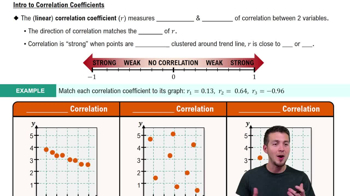
Correlation Coefficient
Scatterplot
A scatterplot is a graphical representation of two quantitative variables, where each point represents an observation. The position of each point on the horizontal and vertical axes indicates the values of the two variables. In this case, the scatterplot shows two distinct clusters of points, which suggests a potential relationship between the variables, and analyzing these clusters can provide insights into the correlation.
Recommended video:
Guided course
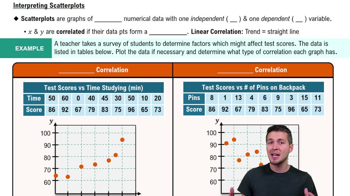
Scatterplots & Intro to Correlation
Clusters in Data
Clusters in data refer to groups of data points that are closely positioned together in a scatterplot, indicating similar values for the variables being analyzed. In this scenario, the points representing women and men form two separate clusters, suggesting that there may be different relationships or characteristics between the two groups. Understanding these clusters is essential for interpreting the correlation coefficient and the overall relationship between the variables.
Recommended video:
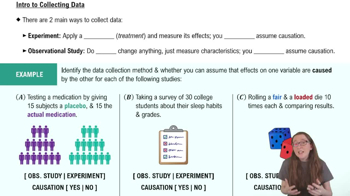
Introduction to Collecting Data
Watch next
Master Find 5-Number Summary - TI-84 Calculator with a bite sized video explanation from Patrick
Start learningRelated Videos
Related Practice
Textbook Question
86
views