In residuals analysis, what should the residual plot look like if the regression line fits the data well?
Table of contents
- 1. Intro to Stats and Collecting Data1h 14m
- 2. Describing Data with Tables and Graphs1h 55m
- 3. Describing Data Numerically2h 5m
- 4. Probability2h 16m
- 5. Binomial Distribution & Discrete Random Variables3h 6m
- 6. Normal Distribution and Continuous Random Variables2h 11m
- 7. Sampling Distributions & Confidence Intervals: Mean3h 23m
- Sampling Distribution of the Sample Mean and Central Limit Theorem19m
- Distribution of Sample Mean - Excel23m
- Introduction to Confidence Intervals15m
- Confidence Intervals for Population Mean1h 18m
- Determining the Minimum Sample Size Required12m
- Finding Probabilities and T Critical Values - Excel28m
- Confidence Intervals for Population Means - Excel25m
- 8. Sampling Distributions & Confidence Intervals: Proportion2h 10m
- 9. Hypothesis Testing for One Sample5h 9m
- Steps in Hypothesis Testing1h 6m
- Performing Hypothesis Tests: Means1h 4m
- Hypothesis Testing: Means - Excel42m
- Performing Hypothesis Tests: Proportions37m
- Hypothesis Testing: Proportions - Excel27m
- Performing Hypothesis Tests: Variance12m
- Critical Values and Rejection Regions28m
- Link Between Confidence Intervals and Hypothesis Testing12m
- Type I & Type II Errors17m
- 10. Hypothesis Testing for Two Samples5h 37m
- Two Proportions1h 13m
- Two Proportions Hypothesis Test - Excel28m
- Two Means - Unknown, Unequal Variance1h 3m
- Two Means - Unknown Variances Hypothesis Test - Excel12m
- Two Means - Unknown, Equal Variance15m
- Two Means - Unknown, Equal Variances Hypothesis Test - Excel9m
- Two Means - Known Variance12m
- Two Means - Sigma Known Hypothesis Test - Excel21m
- Two Means - Matched Pairs (Dependent Samples)42m
- Matched Pairs Hypothesis Test - Excel12m
- Two Variances and F Distribution29m
- Two Variances - Graphing Calculator16m
- 11. Correlation1h 24m
- 12. Regression3h 33m
- Linear Regression & Least Squares Method26m
- Residuals12m
- Coefficient of Determination12m
- Regression Line Equation and Coefficient of Determination - Excel8m
- Finding Residuals and Creating Residual Plots - Excel11m
- Inferences for Slope31m
- Enabling Data Analysis Toolpak1m
- Regression Readout of the Data Analysis Toolpak - Excel21m
- Prediction Intervals13m
- Prediction Intervals - Excel19m
- Multiple Regression - Excel29m
- Quadratic Regression15m
- Quadratic Regression - Excel10m
- 13. Chi-Square Tests & Goodness of Fit2h 21m
- 14. ANOVA1h 57m
12. Regression
Residuals
Problem 12.T.8b
Textbook Question
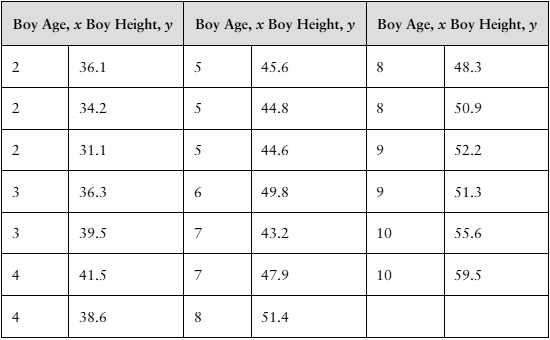
[DATA] The following data represent the height (inches) of boys between the ages of 2 and 10 years.

b. Compute the standard error of the estimate, Sₑ.
Verified step by step guidance1
Step 1: Understand that the standard error of the estimate, \(S_{e}\), measures the standard deviation of the observed values from the predicted values in a regression model. It quantifies the accuracy of predictions made by the regression line.
Step 2: Calculate the predicted heights (\(\hat{y}\)) for each boy's age (\(x\)) using the regression equation \(\hat{y} = b_0 + b_1 x\), where \(b_0\) is the intercept and \(b_1\) is the slope of the regression line. These values should be given or calculated from the data.
Step 3: Compute the residuals for each data point, which are the differences between the observed heights (\(y\)) and the predicted heights (\(\hat{y}\)): \(e_i = y_i - \hat{y}_i\).
Step 4: Square each residual to get \(e_i^2\), then sum all squared residuals: \(\sum e_i^2\).
Step 5: Use the formula for the standard error of the estimate:
\[S_{e} = \sqrt{\frac{\sum e_i^2}{n - 2}}\]
where \(n\) is the number of data points. This formula accounts for the degrees of freedom in simple linear regression.
Verified video answer for a similar problem:This video solution was recommended by our tutors as helpful for the problem above
Video duration:
10mPlay a video:
Was this helpful?
Key Concepts
Here are the essential concepts you must grasp in order to answer the question correctly.
Standard Error of the Estimate (Sₑ)
The standard error of the estimate measures the average distance that observed values fall from the regression line. It quantifies the accuracy of predictions made by a regression model, showing how well the model fits the data. A smaller Sₑ indicates a better fit and more precise predictions.
Recommended video:
Guided course
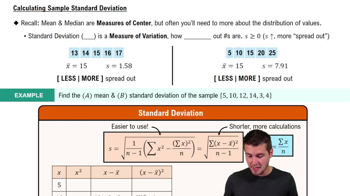
Calculating Standard Deviation
Linear Regression and Residuals
Linear regression models the relationship between an independent variable (age) and a dependent variable (height) by fitting a line. Residuals are the differences between observed values and predicted values from this line. Calculating residuals is essential for determining the standard error of the estimate.
Recommended video:
Guided course
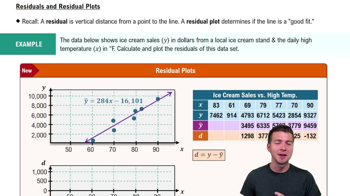
Residuals and Residual Plots
Sum of Squared Residuals (SSR)
The sum of squared residuals is the total of the squared differences between observed and predicted values. It is used to calculate the variance of residuals, which in turn helps compute the standard error of the estimate. SSR reflects the unexplained variation by the regression model.
Recommended video:
Guided course
Residuals and Residual Plots
Watch next
Master Residuals and Residual Plots with a bite sized video explanation from Patrick
Start learningRelated Videos
Related Practice
Multiple Choice
35
views