What does it mean when two events are complements?
Table of contents
- 1. Intro to Stats and Collecting Data1h 14m
- 2. Describing Data with Tables and Graphs1h 55m
- 3. Describing Data Numerically2h 5m
- 4. Probability2h 16m
- 5. Binomial Distribution & Discrete Random Variables3h 6m
- 6. Normal Distribution and Continuous Random Variables2h 11m
- 7. Sampling Distributions & Confidence Intervals: Mean3h 23m
- Sampling Distribution of the Sample Mean and Central Limit Theorem19m
- Distribution of Sample Mean - Excel23m
- Introduction to Confidence Intervals15m
- Confidence Intervals for Population Mean1h 18m
- Determining the Minimum Sample Size Required12m
- Finding Probabilities and T Critical Values - Excel28m
- Confidence Intervals for Population Means - Excel25m
- 8. Sampling Distributions & Confidence Intervals: Proportion1h 25m
- 9. Hypothesis Testing for One Sample3h 29m
- 10. Hypothesis Testing for Two Samples4h 50m
- Two Proportions1h 13m
- Two Proportions Hypothesis Test - Excel28m
- Two Means - Unknown, Unequal Variance1h 3m
- Two Means - Unknown Variances Hypothesis Test - Excel12m
- Two Means - Unknown, Equal Variance15m
- Two Means - Unknown, Equal Variances Hypothesis Test - Excel9m
- Two Means - Known Variance12m
- Two Means - Sigma Known Hypothesis Test - Excel21m
- Two Means - Matched Pairs (Dependent Samples)42m
- Matched Pairs Hypothesis Test - Excel12m
- 11. Correlation1h 24m
- 12. Regression1h 50m
- 13. Chi-Square Tests & Goodness of Fit2h 21m
- 14. ANOVA1h 57m
4. Probability
Complements
Problem 5.3.17c
Textbook Question
[NW] Life Expectancy
The probability that a randomly selected 40-year-old male will live to be 41 years old is 0.99757, according to the National Vital Statistics Report, Vol. 56, No. 9.
c. What is the probability that at least one of five randomly selected 40-year-old males will not live to be 41 years old? Would it be unusual if at least one of five randomly selected 40-year-old males did not live to be 41 years old?
Verified step by step guidance1
Identify the probability that a 40-year-old male will not live to be 41 years old. Since the probability of living to 41 is given as \$0.99757\(, the probability of not living to 41 is \)1 - 0.99757$.
Define the event of interest: "at least one of five males does not live to be 41." This is the complement of the event "all five males live to be 41."
Calculate the probability that all five males live to be 41 by raising the individual survival probability to the power of 5: \((0.99757)^5\).
Use the complement rule to find the probability that at least one male does not live to be 41: \$1 - (0.99757)^5$.
To determine if this event is unusual, compare the calculated probability to a common threshold for unusual events (often 0.05). If the probability is less than this threshold, the event is considered unusual; otherwise, it is not.
Verified video answer for a similar problem:This video solution was recommended by our tutors as helpful for the problem above
Video duration:
3mPlay a video:
Was this helpful?
Key Concepts
Here are the essential concepts you must grasp in order to answer the question correctly.
Complement Rule
The complement rule states that the probability of an event not occurring is one minus the probability that it does occur. In this problem, the probability that a 40-year-old male does not live to 41 is the complement of living to 41, calculated as 1 minus 0.99757.
Recommended video:
Conditional Probability Rule
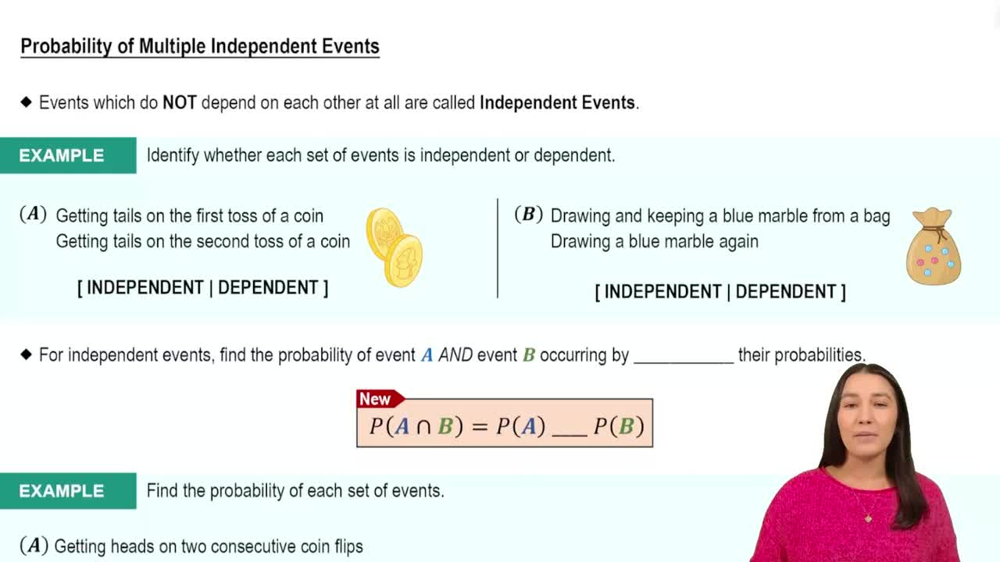
Independent Events
Independent events are those whose outcomes do not affect each other. Here, the survival of each of the five males is assumed independent, allowing us to multiply probabilities when calculating the chance that all survive or at least one does not.
Recommended video:
Probability of Multiple Independent Events
Probability of 'At Least One' Event
The probability that at least one event occurs among several trials is found by subtracting the probability that none occur from 1. For five males, the chance that at least one does not survive is 1 minus the probability that all five survive.
Recommended video:
Probability of Multiple Independent Events
Watch next
Master Complementary Events with a bite sized video explanation from Patrick
Start learningRelated Videos
Related Practice
Textbook Question
10
views