
Gas Mileage The table shows the gas mileages (in miles per gallon) of eight cars with and without using a fuel additive. At α=0.10, is there enough evidence to conclude that the additive improved gas mileage? Assume the populations are normally distributed.
Table of contents
- 1. Intro to Stats and Collecting Data1h 14m
- 2. Describing Data with Tables and Graphs1h 55m
- 3. Describing Data Numerically2h 5m
- 4. Probability2h 16m
- 5. Binomial Distribution & Discrete Random Variables3h 6m
- 6. Normal Distribution and Continuous Random Variables2h 11m
- 7. Sampling Distributions & Confidence Intervals: Mean3h 23m
- Sampling Distribution of the Sample Mean and Central Limit Theorem19m
- Distribution of Sample Mean - Excel23m
- Introduction to Confidence Intervals15m
- Confidence Intervals for Population Mean1h 18m
- Determining the Minimum Sample Size Required12m
- Finding Probabilities and T Critical Values - Excel28m
- Confidence Intervals for Population Means - Excel25m
- 8. Sampling Distributions & Confidence Intervals: Proportion1h 25m
- 9. Hypothesis Testing for One Sample3h 29m
- 10. Hypothesis Testing for Two Samples4h 50m
- Two Proportions1h 13m
- Two Proportions Hypothesis Test - Excel28m
- Two Means - Unknown, Unequal Variance1h 3m
- Two Means - Unknown Variances Hypothesis Test - Excel12m
- Two Means - Unknown, Equal Variance15m
- Two Means - Unknown, Equal Variances Hypothesis Test - Excel9m
- Two Means - Known Variance12m
- Two Means - Sigma Known Hypothesis Test - Excel21m
- Two Means - Matched Pairs (Dependent Samples)42m
- Matched Pairs Hypothesis Test - Excel12m
- 11. Correlation1h 24m
- 12. Regression1h 50m
- 13. Chi-Square Tests & Goodness of Fit2h 21m
- 14. ANOVA1h 57m
10. Hypothesis Testing for Two Samples
Two Means - Matched Pairs (Dependent Samples)
Problem 8.3.9c
Textbook Question
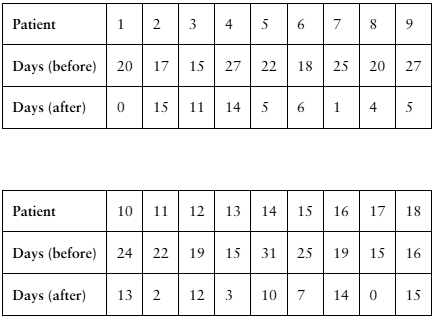
Testing the Difference Between Two Means (c) calculate d̄ and Sd, Assume the samples are random and dependent, and the populations are normally distributed.
[APPLET] Migraines
A researcher claims that injections of onabotulinumtoxinA reduce the number of days per month that chronic migraine sufferers have headaches. The table shows the number of days chronic migraine sufferers suffered migraines before and after using the treatment. At , α= 0.01 is there enough evidence to support the researcher’s claim? (Adapted from Journal of Headache and Pain)

Verified step by step guidance1
Step 1: Calculate the differences (d) for each patient by subtracting the 'Days after' value from the 'Days before' value. For example, for Patient 1, d = 20 - 0 = 20.
Step 2: Compute the mean of the differences (d̄) by summing all the differences and dividing by the total number of patients. Use the formula: , where n is the number of patients.
Step 3: Calculate the standard deviation of the differences (Sd) using the formula: , where d̄ is the mean difference and n is the number of patients.
Step 4: Perform a t-test for dependent samples to test the null hypothesis that the mean difference is zero. Use the formula for the t-statistic: , where Sd is the standard deviation of the differences and n is the number of patients.
Step 5: Compare the calculated t-statistic to the critical t-value at α = 0.01 and degrees of freedom (df = n - 1). If the calculated t-statistic exceeds the critical t-value, reject the null hypothesis and conclude that there is enough evidence to support the researcher's claim.
Verified video answer for a similar problem:This video solution was recommended by our tutors as helpful for the problem above
Video duration:
7mPlay a video:
Was this helpful?
Key Concepts
Here are the essential concepts you must grasp in order to answer the question correctly.
Dependent Samples
Dependent samples, also known as paired samples, occur when the same subjects are measured under different conditions or at different times. In this context, the number of migraine days before and after treatment for the same patients is compared. This design helps control for individual variability, allowing for a more accurate assessment of the treatment's effect.
Recommended video:
Multiplication Rule: Dependent Events
Mean Difference (d̄)
The mean difference (d̄) is calculated by finding the average of the differences between paired observations. In this case, it represents the average change in the number of migraine days for patients before and after receiving the treatment. This statistic is crucial for determining whether the treatment has a significant effect on reducing migraine days.
Recommended video:
Guided course
Difference in Means: Confidence Intervals
Standard Deviation of Differences (Sd)
The standard deviation of differences (Sd) measures the variability of the differences between paired observations. It provides insight into how consistent the treatment effect is across patients. A smaller Sd indicates that the treatment has a more uniform effect, while a larger Sd suggests greater variability in responses, which is important for hypothesis testing.
Recommended video:
Guided course
Calculating Standard Deviation
Watch next
Master Introduction to Matched Pairs with a bite sized video explanation from Patrick
Start learningRelated Videos
Related Practice
Textbook Question
13
views
