True or False: To construct a confidence interval about a population variance or standard deviation, either the population from which the sample is drawn must be normal, or the sample size must be large.
Table of contents
- 1. Intro to Stats and Collecting Data1h 14m
- 2. Describing Data with Tables and Graphs1h 55m
- 3. Describing Data Numerically2h 5m
- 4. Probability2h 16m
- 5. Binomial Distribution & Discrete Random Variables3h 6m
- 6. Normal Distribution and Continuous Random Variables2h 11m
- 7. Sampling Distributions & Confidence Intervals: Mean3h 23m
- Sampling Distribution of the Sample Mean and Central Limit Theorem19m
- Distribution of Sample Mean - Excel23m
- Introduction to Confidence Intervals15m
- Confidence Intervals for Population Mean1h 18m
- Determining the Minimum Sample Size Required12m
- Finding Probabilities and T Critical Values - Excel28m
- Confidence Intervals for Population Means - Excel25m
- 8. Sampling Distributions & Confidence Intervals: Proportion1h 25m
- 9. Hypothesis Testing for One Sample3h 29m
- 10. Hypothesis Testing for Two Samples4h 50m
- Two Proportions1h 13m
- Two Proportions Hypothesis Test - Excel28m
- Two Means - Unknown, Unequal Variance1h 3m
- Two Means - Unknown Variances Hypothesis Test - Excel12m
- Two Means - Unknown, Equal Variance15m
- Two Means - Unknown, Equal Variances Hypothesis Test - Excel9m
- Two Means - Known Variance12m
- Two Means - Sigma Known Hypothesis Test - Excel21m
- Two Means - Matched Pairs (Dependent Samples)42m
- Matched Pairs Hypothesis Test - Excel12m
- 11. Correlation1h 24m
- 12. Regression1h 50m
- 13. Chi-Square Tests & Goodness of Fit2h 21m
- 14. ANOVA1h 57m
7. Sampling Distributions & Confidence Intervals: Mean
Introduction to Confidence Intervals
Problem 9.R.5
Textbook Question
The area under the t-distribution with 18 degrees of freedom to the right of t = 1.56 is 0.0681. What is the area under the t-distribution with 18 degrees of freedom to the left of t = –1.56? Why?
Verified step by step guidance1
Understand that the t-distribution is symmetric about zero, meaning the shape on the left side mirrors the shape on the right side.
Given the area to the right of t = 1.56 with 18 degrees of freedom is 0.0681, recognize that this area corresponds to the tail probability on the positive side.
Because of symmetry, the area to the left of t = -1.56 is equal to the area to the right of t = 1.56.
Therefore, the area to the left of t = -1.56 is also 0.0681.
Summarize that the symmetry property of the t-distribution allows us to conclude that \(P(T < -1.56) = P(T > 1.56) = 0.0681\) for \(T\) with 18 degrees of freedom.
Verified video answer for a similar problem:This video solution was recommended by our tutors as helpful for the problem above
Video duration:
2mPlay a video:
Was this helpful?
Key Concepts
Here are the essential concepts you must grasp in order to answer the question correctly.
t-Distribution
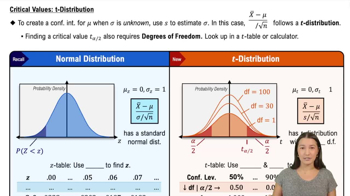
The t-distribution is a probability distribution used in statistics when estimating population parameters with small sample sizes. It is symmetric and bell-shaped like the normal distribution but has heavier tails, which account for extra uncertainty. The shape depends on degrees of freedom, affecting the spread and tail thickness.
Recommended video:
Critical Values: t-Distribution
Degrees of Freedom
Degrees of freedom (df) refer to the number of independent values that can vary in an analysis without breaking any constraints. In the t-distribution, df typically equals the sample size minus one. The value of df influences the shape of the t-distribution, with higher df making it closer to the normal distribution.
Recommended video:
Critical Values: t-Distribution
Symmetry of the t-Distribution
The t-distribution is symmetric about zero, meaning the area to the right of a positive t-value equals the area to the left of its negative counterpart. Therefore, the area to the left of t = –1.56 is the same as the area to the right of t = 1.56, which is 0.0681 in this case.
Recommended video:
Critical Values: t-Distribution
Watch next
Master Introduction to Confidence Intervals with a bite sized video explanation from Patrick
Start learningRelated Videos
Related Practice
Textbook Question
7
views