
Ch. 4 - Probability
Triola - Elementary Statistics 14th Edition
Triola14th EditionElementary StatisticsISBN: 9780137366446Not the one you use?Change textbook
Chapter 4, Problem 4.RE.4

In Exercises 1–10, use the data in the accompanying table and express all results in decimal form. (The data are from “The Left-Handed: Their Sinister History,” by Elaine Fowler Costas, Education Resources Information Center, Paper 399519.)


Table showing the number of left-handed males and females, with counts for those who write with their left hand and those who do not.


Lefty or Female Find the probability of randomly selecting one of the study subjects and getting someone who writes with their left hand or is a female.

Verified step by step guidance
1
Step 1: Understand the problem. We are tasked with finding the probability of randomly selecting a study subject who either writes with their left hand or is a female. This involves using the formula for the union of two events: P(A or B) = P(A) + P(B) - P(A and B).
Step 2: Calculate the total number of study subjects. Add all the values in the table: Total = 23 (Male Left-Handed) + 217 (Male Right-Handed) + 65 (Female Left-Handed) + 455 (Female Right-Handed).
Step 3: Calculate P(A), the probability of selecting someone who writes with their left hand. Add the number of left-handed males and females (23 + 65), then divide by the total number of study subjects.
Step 4: Calculate P(B), the probability of selecting someone who is female. Add the number of females (65 + 455), then divide by the total number of study subjects.
Step 5: Calculate P(A and B), the probability of selecting someone who is both female and writes with their left hand. This is simply the number of left-handed females (65) divided by the total number of study subjects. Finally, use the formula P(A or B) = P(A) + P(B) - P(A and B) to find the desired probability.

Verified video answer for a similar problem:

This video solution was recommended by our tutors as helpful for the problem above.
Video duration:
3m
Was this helpful?

Key Concepts

Here are the essential concepts you must grasp in order to answer the question correctly.

Probability

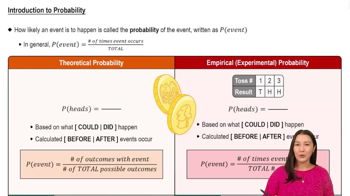
Probability is a measure of the likelihood that a particular event will occur, expressed as a number between 0 and 1. In this context, it involves calculating the chance of randomly selecting a subject who either writes with their left hand or is female. The formula for probability is the number of favorable outcomes divided by the total number of possible outcomes.
Recommended video:
5:37
Introduction to Probability

Union of Events

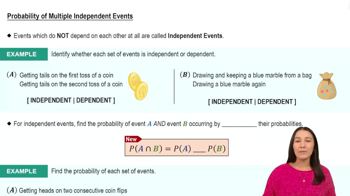
The union of events refers to the occurrence of at least one of two or more events. In this question, we are interested in the union of two events: selecting someone who writes with their left hand and selecting a female. The probability of the union can be calculated using the formula P(A or B) = P(A) + P(B) - P(A and B), where A and B are the two events.
Recommended video:
05:54
Probability of Multiple Independent Events

Data Representation

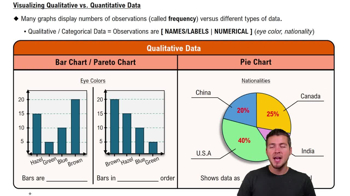
Data representation involves organizing and displaying data in a way that makes it easy to analyze and interpret. In this case, the data is presented in a contingency table that categorizes subjects based on gender and whether they write with their left hand. Understanding how to read and interpret this table is crucial for calculating the required probabilities.
Recommended video:
Guided course
04:39
Visualizing Qualitative vs. Quantitative Data
Related Practice
Textbook Question

In Exercises 1–10, use the data in the accompanying table and express all results in decimal form. (The data are from “The Left-Handed: Their Sinister History,” by Elaine Fowler Costas, Education Resources Information Center, Paper 399519.)


" style="" width="320">


Both Lefties If two of the study subjects are randomly selected with replacement, find the probability that they both write with their left hand.

141
views
Textbook Question

Florida Pick 3 In the Florida Pick 3 lottery, you can place a “straight” bet of \(1 by selecting the exact order of three digits between 0 and 9 inclusive (with repetition allowed), so the probability of winning is 1/1000. If the same three numbers are drawn in the same order, you collect \)500, so your net profit is \$499.


a. Find the actual odds against winning.

189
views
Textbook Question

Heights of Presidents Theories have been developed about the heights of winning candidates for the U.S. presidency and the heights of candidates who were runners up. Listed below are heights (cm) from recent presidential elections. Construct a graph suitable for exploring an association between heights of presidents and the heights of the presidential candidates who were runners-up. What does the graph suggest about that association?

122
views
Textbook Question

Vision Correction About 75% of the U.S. population uses some type of vision correction (such as glasses or contact lenses).


b. If four different people are randomly selected, what is the probability that they all use vision correction?

168
views
Textbook Question

Sampling Eye Color Based on a study by Dr. P. Sorita Soni at Indiana University, assume that eye colors in the United States are distributed as follows: 40% brown, 35% blue, 12% green, 7% gray, 6% hazel.


a. A statistics instructor collects eye color data from her students. What is the name for this type of sample?

227
views
Textbook Question

Cloud Seeding The “Florida Area Cumulus Experiment” was conducted by using silver iodide to seed clouds with the objective of increasing rainfall. For the purposes of this exercise, let the daily amounts of rainfall be represented by units of rnfl. (The actual rainfall amounts are in or )

Find the value of the following statistics and include appropriate units based on rnfl as the unit of measurement.


[Image]


c. midrange

d. range

153
views