
Ch. 4 - Probability
Triola - Elementary Statistics 14th Edition
Triola14th EditionElementary StatisticsISBN: 9780137366446Not the one you use?Change textbook
Chapter 4, Problem 4.2.23

In Exercises 21–24, use these results from the “1-Panel-THC” test for marijuana use, which is provided by the company Drug Test Success: Among 143 subjects with positive test results, there are 24 false positive (incorrect) results; among 157 negative results, there are 3 false negative (incorrect) results. (Hint: Construct a table similar to Table 4-1.)


Testing for Marijuana Use If one of the test subjects is randomly selected, find the probability that the subject tested positive or did not use marijuana.

Verified step by step guidance
1
Step 1: Organize the given data into a contingency table. Create a table with rows representing 'Test Result' (Positive or Negative) and columns representing 'Actual Use' (Used or Did Not Use). Use the provided data: 143 positive test results (24 of which are false positives) and 157 negative test results (3 of which are false negatives).
Step 2: Calculate the true positives and true negatives. True positives are the positive test results that are correct, which is 143 - 24. True negatives are the negative test results that are correct, which is 157 - 3.
Step 3: Fill in the contingency table. Use the calculated true positives, true negatives, false positives, and false negatives to complete the table. Ensure the totals for rows and columns match the given data.
Step 4: Use the contingency table to calculate the probability that the subject tested positive or did not use marijuana. This is the union of two events: (1) the subject tested positive and (2) the subject did not use marijuana. Use the formula for the union of two events: P(A ∪ B) = P(A) + P(B) - P(A ∩ B).
Step 5: Substitute the appropriate probabilities into the formula. P(A) is the probability of testing positive, P(B) is the probability of not using marijuana, and P(A ∩ B) is the probability of testing positive and not using marijuana (false positives). Divide the relevant counts by the total number of subjects to compute these probabilities.

Verified video answer for a similar problem:

This video solution was recommended by our tutors as helpful for the problem above.
Video duration:
5m
Was this helpful?

Key Concepts

Here are the essential concepts you must grasp in order to answer the question correctly.

Probability

Probability is a measure of the likelihood that a particular event will occur, expressed as a number between 0 and 1. In this context, it involves calculating the chances of a subject testing positive for marijuana or not using it at all. Understanding how to compute probabilities from given data is essential for answering the question accurately.
Recommended video:
5:37
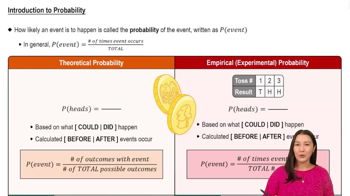
Introduction to Probability

False Positives and False Negatives

False positives occur when a test incorrectly indicates the presence of a condition, while false negatives occur when a test fails to detect a condition that is present. In this scenario, knowing the number of false positives and false negatives helps in determining the accuracy of the test results and affects the overall probability calculations.
Recommended video:
Guided course
05:43
Correlation Coefficient

Contingency Table

A contingency table is a data representation that displays the frequency distribution of variables, allowing for easy comparison of outcomes. Constructing a table based on the test results will help visualize the relationships between true positives, false positives, true negatives, and false negatives, which is crucial for calculating the required probabilities.
Recommended video:
Guided course
09:47
Finding Standard Normal Probabilities using z-Table