Ch. 3 - Probability
Larson - Elementary Statistics: Picturing the World 8th Edition
Larson8th EditionElementary Statistics: Picturing the WorldISBN: 9780137493470Not the one you use?Change textbook
Chapter 3, Problem 3.1.81c

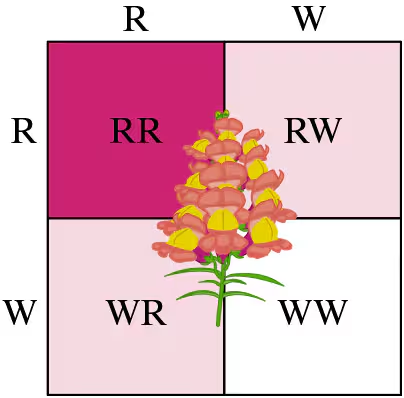
81. Genetics A Punnett square is a diagram that shows all possible gene combinations in a cross of parents whose genes are known. When two pink snapdragon flowers (RW) are crossed, there are four equally likely possible outcomes for the genetic makeup of the offspring: red (RR), pink (RW), pink (WR), and white (WW), as shown in the Punnett square at the left. When two pink snapdragons are crossed, what is the probability that the offspring will be (c) white?
Punnett square showing gene combinations for pink snapdragons, with outcomes: red (RR), pink (RW, WR), and white (WW).

Verified step by step guidance
1
Step 1: Understand the problem. The question asks for the probability that the offspring will be white (WW) when two pink snapdragon flowers (RW) are crossed. The Punnett square provided shows all possible genetic combinations.
Step 2: Analyze the Punnett square. The Punnett square shows four equally likely outcomes: RR, RW, WR, and WW. Each outcome represents a genetic combination of the offspring.
Step 3: Identify the desired outcome. The problem specifically asks for the probability of the offspring being white (WW). Locate the WW cell in the Punnett square.
Step 4: Count the occurrences of the desired outcome. In the Punnett square, there is one WW cell out of the four total cells.
Step 5: Calculate the probability. Since each outcome is equally likely, the probability of the offspring being white (WW) is the number of WW outcomes divided by the total number of outcomes, which is 1/4 or 25%.

Verified video answer for a similar problem:

This video solution was recommended by our tutors as helpful for the problem above.
Video duration:
1m
Was this helpful?

Key Concepts

Here are the essential concepts you must grasp in order to answer the question correctly.

Punnett Square

A Punnett square is a graphical representation used in genetics to predict the possible genotypes of offspring from a cross between two parents. It organizes the alleles contributed by each parent, allowing for a visual assessment of the probability of various genetic combinations. In the case of pink snapdragons, the square illustrates the potential outcomes of crossing two RW (pink) flowers.
Recommended video:
Guided course
07:01
Intro to Least Squares Regression

Genotype and Phenotype

Genotype refers to the genetic makeup of an organism, represented by the alleles inherited from its parents, while phenotype is the observable physical or biochemical characteristics resulting from the genotype. In the example of snapdragons, the genotypes RR, RW, WR, and WW correspond to the phenotypes red, pink, and white flowers, respectively. Understanding this distinction is crucial for interpreting genetic outcomes.

Probability in Genetics

Probability in genetics is used to determine the likelihood of specific traits being expressed in offspring based on parental genotypes. In the context of the Punnett square, the probability of obtaining a particular genotype or phenotype can be calculated by counting the occurrences of each outcome. For the pink snapdragons, the probability of producing a white flower (WW) can be derived from the total combinations shown in the square.
Recommended video:
5:37
Introduction to Probability
Related Practice
Textbook Question

2. Determine whether each number could represent the probability of an event. Explain your reasoning. c. 2.3

183
views

Textbook Question

"Using the Multiplication Rule In Exercises 19-32, use the Multiplication Rule.

24. Knowing a Person Who Was Murdered In a sample of 11,771 children ages 2 to 17, 8% have lost a friend or relative to murder. Four children are selected at random. (Adapted from University of New Hampshire)

c. Find the probability that at least one of the four has lost a friend or relative to murder."

55
views
Textbook Question

Using the Multiplication Rule In Exercises 19-32, use the Multiplication Rule.

26. Worst President In a sample of 1500 adult U.S. citizens, 690 said that Donald Trump was the worst president in U.S. history. Three adult U.S. citizens are selected at random.

(Adapted from YouGov)

c. Find the probability that at most two of the three adult U.S. citizens say that Donald Trump was the worst president in U.S. history.

126
views
Textbook Question

17. Selecting a Card A card is selected at random from a standard deck of 52 playing cards. Find the probability of each event.

c. Randomly selecting a 9 or a face card

388
views
Textbook Question

Mental Health A survey asks 4805 parents the severity of the mental issues they experienced from the coronavirus pandemic. The results are shown in the table. A parent is randomly selected from the sample. Find the probability of each event. (Adapted from Kaiser Family Foundation)

" style="" width="345">

c. The parent did not have major mental health issues or is a mother.

104
views
Textbook Question

23. Engineering Degrees The table shows the numbers of male and female students in the U.S. who received B.S. degrees in engineering in a recent year. A student earning a B.S. degree in engineering during that year is selected at random. Find the probability of each event.

(Source: National Center for Educational Statistics)

c. The student is not female or did not receive a mechanical engineering degree.

82
views