
Ch. 3 - Probability
Larson - Elementary Statistics: Picturing the World 8th Edition
Larson8th EditionElementary Statistics: Picturing the WorldISBN: 9780137493470Not the one you use?Change textbook
Chapter 3, Problem 3.1.87a

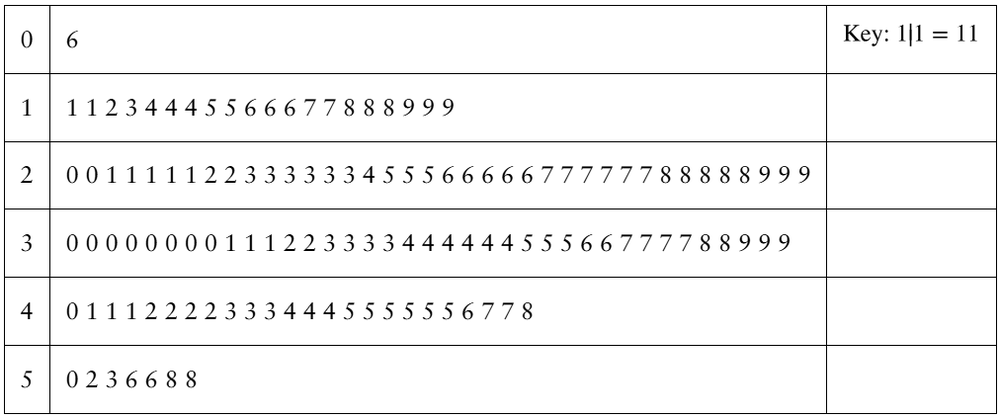
87. College Football A stem-and-leaf plot for the numbers of touchdowns allowed by the 127 NCAA Division I Football Bowl Subdivision teams in the 2020-2021 season is shown. Find the probability that a team chosen at random allowed (a) at least 51 touchdowns. Are any of these events unusual? Explain. (Source: National Collegiate Athletic Association)
<IMAGE>

Verified step by step guidance
1
Step 1: Understand the stem-and-leaf plot. Each row represents the tens digit (stem), and each number in the row represents the units digit (leaf). For example, in the row labeled '5', the numbers 0, 2, 3, 6, 6, 8, and 8 represent 50, 52, 53, 56, 56, 58, and 58 touchdowns respectively.
Step 2: Identify the teams that allowed at least 51 touchdowns. This includes all values in the stem '5' and any values greater than 50 in the stem '4'. Count the total number of these values.
Step 3: Calculate the total number of teams. Count all the leaves across all rows to determine the total number of teams (127 as stated in the problem).
Step 4: Compute the probability. Divide the number of teams that allowed at least 51 touchdowns by the total number of teams. Use the formula: \( P(X \geq 51) = \frac{\text{Number of teams with touchdowns} \geq 51}{\text{Total number of teams}} \).
Step 5: Determine if the event is unusual. An event is considered unusual if its probability is less than 0.05. Compare the calculated probability to 0.05 and explain whether the event is unusual or not.

Verified video answer for a similar problem:

This video solution was recommended by our tutors as helpful for the problem above.
Video duration:
4m
Was this helpful?

Key Concepts

Here are the essential concepts you must grasp in order to answer the question correctly.

Stem-and-Leaf Plot

A stem-and-leaf plot is a graphical representation used to display quantitative data in a way that retains the original data values while showing their distribution. Each number is split into a 'stem' (the leading digit or digits) and a 'leaf' (the trailing digit). This format allows for easy visualization of the data's shape and helps identify the frequency of values within specific ranges.
Recommended video:
06:23
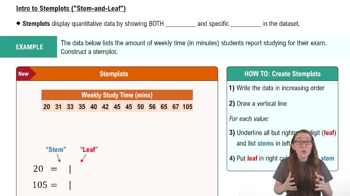
Creating Stemplots

Probability

Probability is a measure of the likelihood that a particular event will occur, expressed as a number between 0 and 1. In this context, it involves calculating the proportion of teams that allowed at least 51 touchdowns out of the total number of teams. Understanding how to compute probabilities is essential for making inferences about data and assessing the likelihood of various outcomes.
Recommended video:
5:37
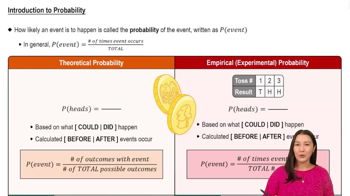
Introduction to Probability

Unusual Events

An event is considered unusual if its probability is significantly low, often defined as less than 5%. In the context of this question, determining whether the event of a team allowing at least 51 touchdowns is unusual involves calculating its probability and comparing it to this threshold. This concept helps in understanding the rarity of certain outcomes within a dataset.
Recommended video:
05:54
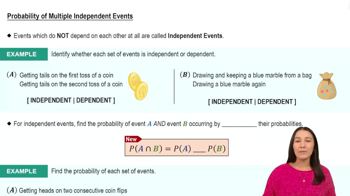
Probability of Multiple Independent Events
Related Practice
Textbook Question

"Finding Conditional Probabilities In Exercises 7 and 8, use the table to find each conditional probability.

8. Retirement Savings The table shows the results of a survey in which 250 male and 250 female workers ages 25 to 64 were asked if they contribute to a retirement savings plan at

work.

a. Find the probability that a randomly selected worker contributes to a retirement savings plan at work, given that the worker is male.

"

53
views
Textbook Question

"39. Reliability of Testing A virus infects one in every 200 people. A test used to detect the virus in a person is positive 80% of the time when the person has the virus and 5% of the time when the person does not have the virus. (This 5% result is called a false positive.) Let A be the event ""the person is infected"" and B be the event ""the person tests positive.""

a. Using Bayes' Theorem, when a person tests positive, determine the probability that the person is infected."

106
views
Textbook Question

50. Investment Committee A company has 200 employees, consisting of 144 women and 56 men. The company wants to select five employees to serve as an investment committee.

a. Use technology to find the number of ways that 5 employees can be selected from 200.

80
views
Textbook Question

"Using the Multiplication Rule In Exercises 19-32, use the Multiplication Rule.

21. BRCA1 Gene Research has shown that approximately 1 woman in 400 carries a mutation of the BRCA1 gene. About 64% of women with this mutation develop breast

cancer. Find the probability that a randomly selected woman will carry the mutation of the BRCA1 gene and will develop breast cancer. (Source: National Cancer Institute)

53
views
Textbook Question

Marijuana Use The percent distribution of the last marijuana use (either medical or nonmedical) for a sample of 13,373 college students is shown in the pie chart. Find the

probability of each event. (Source: American College Health Association)

a. Randomly selecting a student who never used marijuana

89
views
Textbook Question

Using the Multiplication Rule In Exercises 19-32, use the Multiplication Rule.

25. Best President In a sample of 1500 adult U.S. citizens, 270 said that Barack Obama was the best president in U.S. history. Two adult U.S. citizens are selected at random.

(Adapted from YouGov)

a. Find the probability that both adult U.S. citizens say that Barack Obama was the best president in U.S. history.

91
views