
Faculty Classroom Hours The dean of a university estimates that the mean number of classroom hours per week for full-time faculty is 11.0. As a member of the student council, you want to test this claim. A random sample of the number of classroom hours for eight full-time faculty for one week is shown in the table at the left. At α=0.01, can you reject the dean’s claim?
Table of contents
- 1. Intro to Stats and Collecting Data1h 14m
- 2. Describing Data with Tables and Graphs1h 55m
- 3. Describing Data Numerically2h 5m
- 4. Probability2h 16m
- 5. Binomial Distribution & Discrete Random Variables3h 6m
- 6. Normal Distribution and Continuous Random Variables2h 11m
- 7. Sampling Distributions & Confidence Intervals: Mean3h 23m
- Sampling Distribution of the Sample Mean and Central Limit Theorem19m
- Distribution of Sample Mean - Excel23m
- Introduction to Confidence Intervals15m
- Confidence Intervals for Population Mean1h 18m
- Determining the Minimum Sample Size Required12m
- Finding Probabilities and T Critical Values - Excel28m
- Confidence Intervals for Population Means - Excel25m
- 8. Sampling Distributions & Confidence Intervals: Proportion1h 25m
- 9. Hypothesis Testing for One Sample3h 29m
- 10. Hypothesis Testing for Two Samples4h 50m
- Two Proportions1h 13m
- Two Proportions Hypothesis Test - Excel28m
- Two Means - Unknown, Unequal Variance1h 3m
- Two Means - Unknown Variances Hypothesis Test - Excel12m
- Two Means - Unknown, Equal Variance15m
- Two Means - Unknown, Equal Variances Hypothesis Test - Excel9m
- Two Means - Known Variance12m
- Two Means - Sigma Known Hypothesis Test - Excel21m
- Two Means - Matched Pairs (Dependent Samples)42m
- Matched Pairs Hypothesis Test - Excel12m
- 11. Correlation1h 24m
- 12. Regression1h 50m
- 13. Chi-Square Tests & Goodness of Fit2h 21m
- 14. ANOVA1h 57m
9. Hypothesis Testing for One Sample
Performing Hypothesis Tests: Means
Problem 7.Q.2
Textbook Question
A travel analyst claims the mean daily base price for renting a full-size or less expensive vehicle in Vancouver, British Columbia, is more than \$86. You want to test this claim. In a random sample of 40 full-size or less expensive vehicles available to rent in Vancouver, British Columbia, the mean daily base price is \$93.23. Assume the population standard deviation is \$28.90. At α=0.10, do you have enough evidence to support the analyst’s claim?
Verified step by step guidance1
Step 1: Define the null hypothesis (H₀) and the alternative hypothesis (H₁). The null hypothesis is H₀: μ ≤ 86, which states that the mean daily base price is less than or equal to \$86. The alternative hypothesis is H₁: μ > 86, which states that the mean daily base price is greater than \$86. This is a one-tailed test.
Step 2: Identify the test statistic to use. Since the population standard deviation (σ) is known, use the z-test for the hypothesis test. The formula for the z-test statistic is: , where x̄ is the sample mean, μ is the hypothesized population mean, σ is the population standard deviation, and n is the sample size.
Step 3: Substitute the given values into the z-test formula. Here, x̄ = 93.23, μ = 86, σ = 28.90, and n = 40. Calculate the standard error of the mean (SE) using the formula: . Then, compute the z-test statistic using the formula from Step 2.
Step 4: Determine the critical value for the z-test at a significance level of α = 0.10. For a one-tailed test, find the z-value that corresponds to an area of 0.10 in the upper tail of the standard normal distribution. Use a z-table or statistical software to find this critical value.
Step 5: Compare the calculated z-test statistic to the critical value. If the z-test statistic is greater than the critical value, reject the null hypothesis (H₀) and conclude that there is enough evidence to support the analyst’s claim. Otherwise, fail to reject the null hypothesis.
Verified video answer for a similar problem:This video solution was recommended by our tutors as helpful for the problem above
Video duration:
4mPlay a video:
Was this helpful?
Key Concepts
Here are the essential concepts you must grasp in order to answer the question correctly.
Hypothesis Testing
Hypothesis testing is a statistical method used to make decisions about a population based on sample data. It involves formulating a null hypothesis (H0) and an alternative hypothesis (H1). In this case, the null hypothesis would state that the mean daily base price is less than or equal to $86, while the alternative hypothesis would assert that it is greater than $86. The goal is to determine whether there is enough evidence to reject the null hypothesis in favor of the alternative.
Recommended video:
Guided course
Step 1: Write Hypotheses
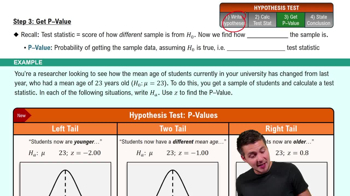
P-Value
The p-value is a measure that helps determine the significance of the results obtained from a statistical test. It represents the probability of observing the sample data, or something more extreme, if the null hypothesis is true. In this scenario, if the p-value is less than the significance level (α = 0.10), it indicates strong evidence against the null hypothesis, suggesting that the mean daily base price is indeed greater than $86.
Recommended video:
Guided course
Step 3: Get P-Value
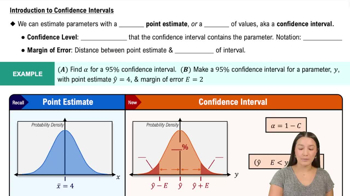
Confidence Intervals
A confidence interval is a range of values, derived from sample statistics, that is likely to contain the population parameter with a specified level of confidence. In this context, constructing a confidence interval for the mean daily base price can provide insight into the range within which the true mean lies. If the entire interval is above $86, it would support the analyst's claim, while an interval that includes $86 would not provide sufficient evidence.
Recommended video:
Introduction to Confidence Intervals
Watch next
Master Standard Deviation (σ) Known with a bite sized video explanation from Patrick
Start learningRelated Videos
Related Practice
Textbook Question
28
views
