"[DATA] Putting It Together: Paternal Smoking It is well-documented that active maternal smoking during pregnancy is associated with lower-birth-weight babies. Researchers wanted to determine if there is a relationship between paternal smoking habits and birth weight. The researchers administered a questionnaire to each parent of newborn infants. One question asked whether the individual smoked regularly. Because the survey was administered within 15 days of birth, it was assumed that any regular smokers were also regular smokers during pregnancy. Birth weights for the babies (in grams) of nonsmoking mothers were obtained and divided into two groups, nonsmoking fathers and smoking fathers. The given data are representative of the data collected by the researchers. The researchers concluded that the birth weight of babies whose father smoked was less than the birth weight of babies whose father did not smoke. a. Is this an observational study or a designed experiment? Why?"
Verified step by step guidance
1
Step 1: Understand the context of the study. The researchers collected birth weight data for babies whose mothers did not smoke, and grouped the data based on whether the fathers smoked or not. The goal was to see if paternal smoking is related to birth weight.
Step 2: Identify the type of study. An observational study involves observing and measuring variables without manipulating any factors, while a designed experiment involves actively assigning treatments to subjects to observe effects.
Step 3: Analyze the data collection method. The researchers administered a questionnaire to parents shortly after birth to determine smoking status, but they did not assign or control who smoked or did not smoke. They simply observed existing conditions.
Step 4: Conclude the study type. Since the researchers did not control or assign smoking habits but only observed and recorded data, this is an observational study.
Step 5: Summarize the reasoning. The study observes natural behavior (smoking status) and its association with birth weight without intervention, which is characteristic of an observational study rather than a designed experiment.
Verified video answer for a similar problem:
This video solution was recommended by our tutors as helpful for the problem above
Video duration:
2m
Play a video:
0 Comments
Key Concepts
Here are the essential concepts you must grasp in order to answer the question correctly.
Observational Study vs. Designed Experiment
An observational study involves observing subjects without manipulating any variables, while a designed experiment involves actively applying treatments to subjects and controlling conditions. In this question, researchers collected data without assigning smoking habits, indicating an observational study.
Confounding variables are factors other than the explanatory variable that may affect the response variable, potentially biasing results. Since paternal smoking is not controlled or randomized, other factors could influence birth weight, making it important to consider confounders.
Intro to Random Variables & Probability Distributions
Data Grouping and Comparison
Data is grouped based on paternal smoking status to compare birth weights between groups. Understanding how to organize and compare data sets is essential for analyzing differences and drawing conclusions about relationships between variables.

 2:26 minutes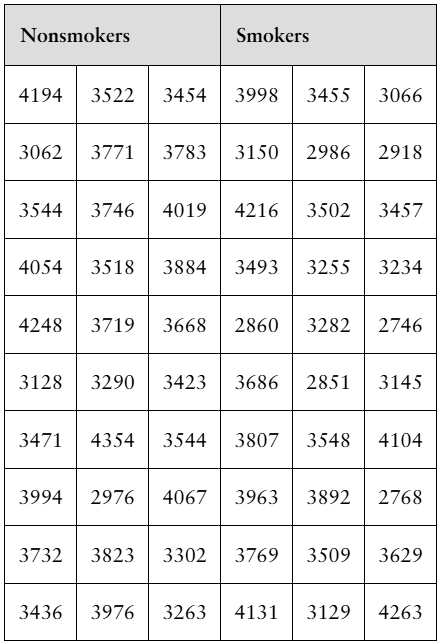
 Verified step by step guidance
 04:39
04:39