You are planning a trip to a water park tomorrow and the weather forecaster says there is a 70% chance of rain. Explain what this result means.
Table of contents
- 1. Intro to Stats and Collecting Data1h 14m
- 2. Describing Data with Tables and Graphs1h 55m
- 3. Describing Data Numerically2h 5m
- 4. Probability2h 16m
- 5. Binomial Distribution & Discrete Random Variables3h 6m
- 6. Normal Distribution and Continuous Random Variables2h 11m
- 7. Sampling Distributions & Confidence Intervals: Mean3h 23m
- Sampling Distribution of the Sample Mean and Central Limit Theorem19m
- Distribution of Sample Mean - Excel23m
- Introduction to Confidence Intervals15m
- Confidence Intervals for Population Mean1h 18m
- Determining the Minimum Sample Size Required12m
- Finding Probabilities and T Critical Values - Excel28m
- Confidence Intervals for Population Means - Excel25m
- 8. Sampling Distributions & Confidence Intervals: Proportion2h 10m
- 9. Hypothesis Testing for One Sample5h 6m
- Steps in Hypothesis Testing1h 6m
- Performing Hypothesis Tests: Means1h 4m
- Hypothesis Testing: Means - Excel42m
- Performing Hypothesis Tests: Proportions37m
- Hypothesis Testing: Proportions - Excel27m
- Performing Hypothesis Tests: Variance12m
- Critical Values and Rejection Regions28m
- Link Between Confidence Intervals and Hypothesis Testing12m
- Type I & Type II Errors15m
- 10. Hypothesis Testing for Two Samples4h 50m
- Two Proportions1h 13m
- Two Proportions Hypothesis Test - Excel28m
- Two Means - Unknown, Unequal Variance1h 3m
- Two Means - Unknown Variances Hypothesis Test - Excel12m
- Two Means - Unknown, Equal Variance15m
- Two Means - Unknown, Equal Variances Hypothesis Test - Excel9m
- Two Means - Known Variance12m
- Two Means - Sigma Known Hypothesis Test - Excel21m
- Two Means - Matched Pairs (Dependent Samples)42m
- Matched Pairs Hypothesis Test - Excel12m
- 11. Correlation1h 24m
- 12. Regression3h 33m
- Linear Regression & Least Squares Method26m
- Residuals12m
- Coefficient of Determination12m
- Regression Line Equation and Coefficient of Determination - Excel8m
- Finding Residuals and Creating Residual Plots - Excel11m
- Inferences for Slope31m
- Enabling Data Analysis Toolpak1m
- Regression Readout of the Data Analysis Toolpak - Excel21m
- Prediction Intervals13m
- Prediction Intervals - Excel19m
- Multiple Regression - Excel29m
- Quadratic Regression15m
- Quadratic Regression - Excel10m
- 13. Chi-Square Tests & Goodness of Fit2h 21m
- 14. ANOVA1h 57m
4. Probability
Basic Concepts of Probability
Problem 5.R.13d
Textbook Question
Roulette
In the game of roulette, the wheel has 38 slots numbered 0, 00, 1, 2, …, 36. A metal ball is spun around the wheel and can land in any of the slots. The slots numbered 0 and 00 are green, the odd numbers are red, and the even numbers are black..
d. Determine the probability that the metal ball lands in both the number 31 slot and a black slot at the same time. What term is used to describe this event?
Verified step by step guidance1
Step 1: Understand the problem context. The roulette wheel has 38 slots: numbers 0, 00, and 1 through 36. The colors are assigned as follows: 0 and 00 are green, odd numbers are red, and even numbers are black.
Step 2: Identify the event of interest. We want the probability that the ball lands on the number 31 slot and also on a black slot at the same time.
Step 3: Analyze the event logically. Since the ball can only land in one slot at a time, it cannot simultaneously land on number 31 and any other slot. Therefore, the event of landing on 31 and landing on a black slot simultaneously is only possible if 31 is black.
Step 4: Determine the color of slot 31. Since 31 is an odd number, it is red, not black. Therefore, the event 'landing on 31 and landing on a black slot at the same time' cannot happen.
Step 5: Conclude the probability and terminology. The probability of this event is zero because it is impossible. This type of event, which cannot occur, is called an 'impossible event' in probability theory.
Verified video answer for a similar problem:This video solution was recommended by our tutors as helpful for the problem above
Video duration:
3mPlay a video:
Was this helpful?
Key Concepts
Here are the essential concepts you must grasp in order to answer the question correctly.
Probability of an Event
Probability measures the likelihood of a specific outcome occurring, expressed as a number between 0 and 1. It is calculated by dividing the number of favorable outcomes by the total number of possible outcomes. For example, the probability of landing on a specific slot in roulette is 1 out of 38.
Recommended video:
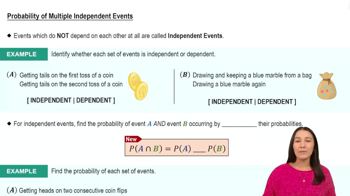
Probability of Multiple Independent Events
Mutually Exclusive Events
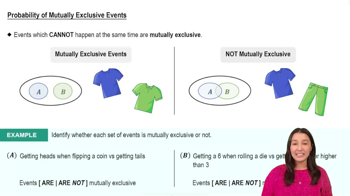
Mutually exclusive events are events that cannot happen at the same time. If one event occurs, the other cannot. In the roulette question, landing on slot 31 and landing on a black slot simultaneously is impossible if slot 31 is not black, making these events mutually exclusive.
Recommended video:
Probability of Mutually Exclusive Events
Intersection of Events
The intersection of two events refers to the event where both occur simultaneously. It is denoted as A ∩ B and its probability is found by considering outcomes common to both events. If no common outcomes exist, the intersection probability is zero.
Recommended video:
Probability of Multiple Independent Events
Watch next
Master Introduction to Probability with a bite sized video explanation from Patrick
Start learningRelated Videos
Related Practice
Textbook Question
8
views