You are planning a trip to a water park tomorrow and the weather forecaster says there is a 70% chance of rain. Explain what this result means.
Table of contents
- 1. Intro to Stats and Collecting Data1h 14m
- 2. Describing Data with Tables and Graphs1h 55m
- 3. Describing Data Numerically2h 5m
- 4. Probability2h 16m
- 5. Binomial Distribution & Discrete Random Variables3h 6m
- 6. Normal Distribution and Continuous Random Variables2h 11m
- 7. Sampling Distributions & Confidence Intervals: Mean3h 23m
- Sampling Distribution of the Sample Mean and Central Limit Theorem19m
- Distribution of Sample Mean - Excel23m
- Introduction to Confidence Intervals15m
- Confidence Intervals for Population Mean1h 18m
- Determining the Minimum Sample Size Required12m
- Finding Probabilities and T Critical Values - Excel28m
- Confidence Intervals for Population Means - Excel25m
- 8. Sampling Distributions & Confidence Intervals: Proportion1h 25m
- 9. Hypothesis Testing for One Sample3h 29m
- 10. Hypothesis Testing for Two Samples4h 50m
- Two Proportions1h 13m
- Two Proportions Hypothesis Test - Excel28m
- Two Means - Unknown, Unequal Variance1h 3m
- Two Means - Unknown Variances Hypothesis Test - Excel12m
- Two Means - Unknown, Equal Variance15m
- Two Means - Unknown, Equal Variances Hypothesis Test - Excel9m
- Two Means - Known Variance12m
- Two Means - Sigma Known Hypothesis Test - Excel21m
- Two Means - Matched Pairs (Dependent Samples)42m
- Matched Pairs Hypothesis Test - Excel12m
- 11. Correlation1h 24m
- 12. Regression1h 50m
- 13. Chi-Square Tests & Goodness of Fit2h 21m
- 14. ANOVA1h 57m
4. Probability
Basic Concepts of Probability
Problem 5.R.15a
Textbook Question
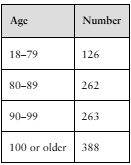
Long Life? In a poll conducted by Genworth Financial, a random sample of adults was asked, “What age would you like to live to?” The results of the survey are given in the table.
a. Construct a probability model of the data.

Verified step by step guidance1
Step 1: Identify the total number of respondents by summing all the frequencies given in the table. This means adding 126 + 262 + 263 + 388 to find the total sample size.
Step 2: Understand that a probability model assigns probabilities to each age group based on the relative frequency of respondents who chose that group. The probability for each age group is the number of respondents in that group divided by the total number of respondents.
Step 3: Calculate the probability for each age group using the formula: \(P(\text{age group}) = \frac{\text{Number in age group}}{\text{Total number of respondents}}\).
Step 4: Write the probability model as a list or table showing each age group paired with its corresponding probability calculated in Step 3.
Step 5: Verify that the sum of all probabilities equals 1, which confirms that the probability model is valid.
Verified video answer for a similar problem:This video solution was recommended by our tutors as helpful for the problem above
Video duration:
3mPlay a video:
Was this helpful?
Key Concepts
Here are the essential concepts you must grasp in order to answer the question correctly.
Probability Model
A probability model assigns probabilities to all possible outcomes of a random experiment. In this context, it involves converting the counts of people preferring each age range into probabilities by dividing each count by the total number of respondents. This model helps describe the likelihood of each age preference.
Recommended video:
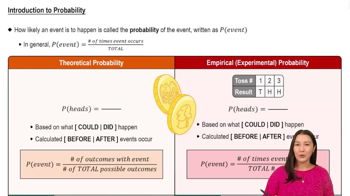
Introduction to Probability
Relative Frequency
Relative frequency is the ratio of the number of times an event occurs to the total number of trials or observations. Here, it is used to estimate the probability of each age group by dividing the number of respondents in that group by the total sample size, providing an empirical probability distribution.
Recommended video:
Guided course
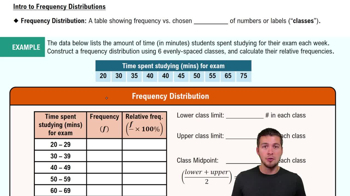
Intro to Frequency Distributions
Random Sampling
Random sampling means selecting individuals from a population in such a way that each member has an equal chance of being chosen. This ensures the sample represents the population fairly, allowing the probability model based on the sample data to be generalized to the larger population.
Recommended video:
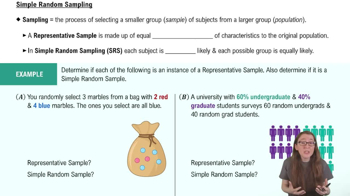
Simple Random Sampling
Watch next
Master Introduction to Probability with a bite sized video explanation from Patrick
Start learningRelated Videos
Related Practice
Textbook Question
4
views