
What is replication in an experiment? Why is replication important?
Table of contents
- 1. Intro to Stats and Collecting Data1h 14m
- 2. Describing Data with Tables and Graphs1h 55m
- 3. Describing Data Numerically2h 5m
- 4. Probability2h 16m
- 5. Binomial Distribution & Discrete Random Variables3h 6m
- 6. Normal Distribution and Continuous Random Variables2h 11m
- 7. Sampling Distributions & Confidence Intervals: Mean3h 23m
- Sampling Distribution of the Sample Mean and Central Limit Theorem19m
- Distribution of Sample Mean - Excel23m
- Introduction to Confidence Intervals15m
- Confidence Intervals for Population Mean1h 18m
- Determining the Minimum Sample Size Required12m
- Finding Probabilities and T Critical Values - Excel28m
- Confidence Intervals for Population Means - Excel25m
- 8. Sampling Distributions & Confidence Intervals: Proportion1h 25m
- 9. Hypothesis Testing for One Sample3h 29m
- 10. Hypothesis Testing for Two Samples4h 50m
- Two Proportions1h 13m
- Two Proportions Hypothesis Test - Excel28m
- Two Means - Unknown, Unequal Variance1h 3m
- Two Means - Unknown Variances Hypothesis Test - Excel12m
- Two Means - Unknown, Equal Variance15m
- Two Means - Unknown, Equal Variances Hypothesis Test - Excel9m
- Two Means - Known Variance12m
- Two Means - Sigma Known Hypothesis Test - Excel21m
- Two Means - Matched Pairs (Dependent Samples)42m
- Matched Pairs Hypothesis Test - Excel12m
- 11. Correlation1h 24m
- 12. Regression1h 50m
- 13. Chi-Square Tests & Goodness of Fit2h 21m
- 14. ANOVA1h 57m
1. Intro to Stats and Collecting Data
Sampling Methods
Problem 1.3.21
Textbook Question
A researcher wants to study the effects of sleep deprivation on motor skills. Eighteen people volunteer for the experiment: Jake, Arya, Xavier, Nyla, Shaniece, Chen, Juan, Hana, Nia, Ansel, Liam, Bruno, Mei, Zoey, Kayla, Liam, Sofia, and Kai. Use a random number generator to choose nine subjects for the treatment group. The other nine subjects will go into the control group. List the subjects in each group. Tell which method you used to generate the random numbers.
Verified step by step guidance1
Step 1: Assign a unique number to each of the 18 participants. For example, Jake = 1, Arya = 2, Xavier = 3, and so on until Kai = 18.
Step 2: Use a random number generator to generate nine unique random numbers between 1 and 18. Ensure that the random number generator does not repeat numbers.
Step 3: Match the generated random numbers to the participants' assigned numbers. These participants will form the treatment group.
Step 4: The remaining participants (those whose numbers were not selected) will automatically be assigned to the control group.
Step 5: Document the method used for generating random numbers (e.g., a computer-based random number generator or a random number table) and list the participants in each group based on the random selection process.
Verified video answer for a similar problem:This video solution was recommended by our tutors as helpful for the problem above
Video duration:
3mPlay a video:
Was this helpful?
Key Concepts
Here are the essential concepts you must grasp in order to answer the question correctly.
Random Sampling
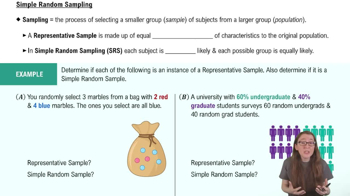
Random sampling is a technique used to select a subset of individuals from a larger population, ensuring that each member has an equal chance of being chosen. This method helps to eliminate bias and allows for the generalization of results to the entire population. In this scenario, the researcher uses random sampling to assign subjects to either the treatment or control group, which is crucial for the validity of the experiment.
Recommended video:
Simple Random Sampling
Control Group vs. Treatment Group
In experimental research, the treatment group receives the intervention or treatment being tested, while the control group does not, serving as a baseline for comparison. This distinction is essential for assessing the effects of the treatment. In this study, the treatment group will experience sleep deprivation, while the control group will not, allowing the researcher to measure the impact on motor skills effectively.
Recommended video:
Guided course
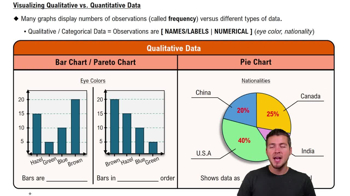
Visualizing Qualitative vs. Quantitative Data
Random Number Generator
A random number generator (RNG) is a tool used to produce a sequence of numbers that lack any pattern, ensuring randomness. In the context of this experiment, the RNG is employed to select which subjects will be assigned to the treatment group, thereby facilitating an unbiased selection process. This method enhances the reliability of the study's findings by ensuring that the groups are comparable.
Recommended video:
Guided course
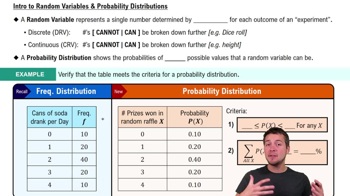
Intro to Random Variables & Probability Distributions
Watch next
Master Simple Random Sampling with a bite sized video explanation from Patrick
Start learningRelated Videos
Related Practice
Textbook Question
79
views
