A quality control manager wants to see how many defective products come off the line on average per day. They select three random cases of units at the end of the day to test how many defective units are in one of the three cases. What type of sampling method is this?
Table of contents
- 1. Intro to Stats and Collecting Data1h 14m
- 2. Describing Data with Tables and Graphs1h 55m
- 3. Describing Data Numerically2h 5m
- 4. Probability2h 16m
- 5. Binomial Distribution & Discrete Random Variables3h 6m
- 6. Normal Distribution and Continuous Random Variables2h 11m
- 7. Sampling Distributions & Confidence Intervals: Mean3h 23m
- Sampling Distribution of the Sample Mean and Central Limit Theorem19m
- Distribution of Sample Mean - Excel23m
- Introduction to Confidence Intervals15m
- Confidence Intervals for Population Mean1h 18m
- Determining the Minimum Sample Size Required12m
- Finding Probabilities and T Critical Values - Excel28m
- Confidence Intervals for Population Means - Excel25m
- 8. Sampling Distributions & Confidence Intervals: Proportion1h 25m
- 9. Hypothesis Testing for One Sample3h 29m
- 10. Hypothesis Testing for Two Samples4h 50m
- Two Proportions1h 13m
- Two Proportions Hypothesis Test - Excel28m
- Two Means - Unknown, Unequal Variance1h 3m
- Two Means - Unknown Variances Hypothesis Test - Excel12m
- Two Means - Unknown, Equal Variance15m
- Two Means - Unknown, Equal Variances Hypothesis Test - Excel9m
- Two Means - Known Variance12m
- Two Means - Sigma Known Hypothesis Test - Excel21m
- Two Means - Matched Pairs (Dependent Samples)42m
- Matched Pairs Hypothesis Test - Excel12m
- 11. Correlation1h 24m
- 12. Regression1h 50m
- 13. Chi-Square Tests & Goodness of Fit2h 21m
- 14. ANOVA1h 57m
1. Intro to Stats and Collecting Data
Sampling Methods
Problem 1.3.4
Textbook Question
What is replication in an experiment? Why is replication important?
Verified step by step guidance1
Replication in an experiment refers to the process of repeating the experiment multiple times under the same conditions to ensure consistency and reliability of the results.
Replication helps to reduce the impact of random errors or variability in the data, which can occur due to uncontrollable factors during the experiment.
By replicating the experiment, researchers can assess the precision of their measurements and determine whether the observed effects are consistent across trials.
Replication also allows for the calculation of statistical measures, such as standard deviation and confidence intervals, which provide insights into the reliability of the results.
In summary, replication is crucial for validating the findings of an experiment and ensuring that the results are not due to chance or isolated occurrences.
Verified video answer for a similar problem:This video solution was recommended by our tutors as helpful for the problem above
Video duration:
2mPlay a video:
Was this helpful?
Key Concepts
Here are the essential concepts you must grasp in order to answer the question correctly.
Replication in Experiments
Replication in experiments refers to the process of repeating a study or experiment to verify the results. This can involve conducting the same experiment multiple times or using different samples to ensure that the findings are consistent and not due to random chance. Replication helps establish the reliability and validity of the experimental results.
Recommended video:
Guided course
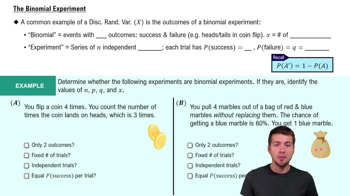
The Binomial Experiment
Statistical Power
Statistical power is the probability that a test will correctly reject a false null hypothesis. Higher replication increases the sample size, which enhances the statistical power of an experiment. This means that with more data points, researchers are better equipped to detect true effects and minimize the risk of Type II errors, where a real effect is missed.
Recommended video:
Guided course
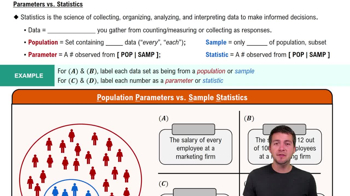
Parameters vs. Statistics
Generalizability
Generalizability refers to the extent to which findings from a study can be applied to broader populations or different contexts. Replication is crucial for assessing generalizability, as consistent results across various studies suggest that the findings are not limited to a specific sample or situation. This enhances the overall credibility of the research.
Watch next
Master Simple Random Sampling with a bite sized video explanation from Patrick
Start learningRelated Videos
Related Practice
Multiple Choice
252
views