
For , & , perform a hypothesis test to test the claim that , assuming for .
Table of contents
- 1. Intro to Stats and Collecting Data1h 14m
- 2. Describing Data with Tables and Graphs1h 55m
- 3. Describing Data Numerically2h 5m
- 4. Probability2h 16m
- 5. Binomial Distribution & Discrete Random Variables3h 6m
- 6. Normal Distribution and Continuous Random Variables2h 11m
- 7. Sampling Distributions & Confidence Intervals: Mean3h 23m
- Sampling Distribution of the Sample Mean and Central Limit Theorem19m
- Distribution of Sample Mean - Excel23m
- Introduction to Confidence Intervals15m
- Confidence Intervals for Population Mean1h 18m
- Determining the Minimum Sample Size Required12m
- Finding Probabilities and T Critical Values - Excel28m
- Confidence Intervals for Population Means - Excel25m
- 8. Sampling Distributions & Confidence Intervals: Proportion2h 10m
- 9. Hypothesis Testing for One Sample5h 9m
- Steps in Hypothesis Testing1h 6m
- Performing Hypothesis Tests: Means1h 4m
- Hypothesis Testing: Means - Excel42m
- Performing Hypothesis Tests: Proportions37m
- Hypothesis Testing: Proportions - Excel27m
- Performing Hypothesis Tests: Variance12m
- Critical Values and Rejection Regions28m
- Link Between Confidence Intervals and Hypothesis Testing12m
- Type I & Type II Errors17m
- 10. Hypothesis Testing for Two Samples5h 37m
- Two Proportions1h 13m
- Two Proportions Hypothesis Test - Excel28m
- Two Means - Unknown, Unequal Variance1h 3m
- Two Means - Unknown Variances Hypothesis Test - Excel12m
- Two Means - Unknown, Equal Variance15m
- Two Means - Unknown, Equal Variances Hypothesis Test - Excel9m
- Two Means - Known Variance12m
- Two Means - Sigma Known Hypothesis Test - Excel21m
- Two Means - Matched Pairs (Dependent Samples)42m
- Matched Pairs Hypothesis Test - Excel12m
- Two Variances and F Distribution29m
- Two Variances - Graphing Calculator16m
- 11. Correlation1h 24m
- 12. Regression3h 33m
- Linear Regression & Least Squares Method26m
- Residuals12m
- Coefficient of Determination12m
- Regression Line Equation and Coefficient of Determination - Excel8m
- Finding Residuals and Creating Residual Plots - Excel11m
- Inferences for Slope31m
- Enabling Data Analysis Toolpak1m
- Regression Readout of the Data Analysis Toolpak - Excel21m
- Prediction Intervals13m
- Prediction Intervals - Excel19m
- Multiple Regression - Excel29m
- Quadratic Regression15m
- Quadratic Regression - Excel10m
- 13. Chi-Square Tests & Goodness of Fit2h 21m
- 14. ANOVA1h 57m
10. Hypothesis Testing for Two Samples
Two Means - Unknown, Equal Variance
Problem 8.2.8a
Textbook Question
Find the critical value(s) for the alternative hypothesis, level of significance , and sample sizes and . Assume that the samples are random and independent, the populations are normally distributed, and the population variances are (a) equal .
Ha:μ1<μ2 , α=0.10 , n1=30 , n2=32
Verified step by step guidance1
Identify the type of test based on the alternative hypothesis. Since the alternative hypothesis is \(H_a: \mu_1 < \mu_2\), this is a left-tailed test.
Determine the level of significance \(\alpha = 0.10\). This means the critical region is in the left tail of the distribution with an area of 0.10.
Since the population variances are assumed equal, use the pooled variance \(s_p^2\) and the \(t\)-distribution with degrees of freedom \(df = n_1 + n_2 - 2\).
Calculate the degrees of freedom: \(df = 30 + 32 - 2 = 60\).
Find the critical value \(t_{\alpha, df}\) from the \(t\)-distribution table corresponding to \(\alpha = 0.10\) in the left tail and \(df = 60\). This critical value will be negative because it is a left-tailed test.
Verified video answer for a similar problem:This video solution was recommended by our tutors as helpful for the problem above
Video duration:
2mPlay a video:
Was this helpful?
Key Concepts
Here are the essential concepts you must grasp in order to answer the question correctly.
Hypothesis Testing and Alternative Hypothesis
Hypothesis testing is a statistical method used to decide whether there is enough evidence to reject a null hypothesis. The alternative hypothesis (Ha: μ1 < μ2) specifies the direction of the test, indicating that the mean of population 1 is less than that of population 2. Understanding the alternative hypothesis guides the selection of the critical region for the test.
Recommended video:
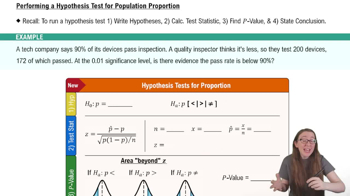
Performing Hypothesis Tests: Proportions
Level of Significance (α)
The level of significance, denoted by α, is the probability of rejecting the null hypothesis when it is actually true (Type I error). In this question, α = 0.10 means there is a 10% risk of a false positive. It determines the critical value(s) that define the rejection region for the test statistic.
Recommended video:
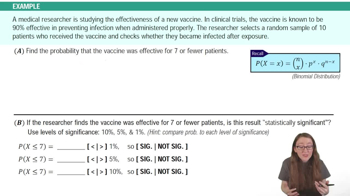
Finding Binomial Probabilities Using TI-84 Example 1
Two-Sample t-Test with Equal Variances
When population variances are assumed equal, a pooled two-sample t-test is used to compare means from two independent samples. The test statistic follows a t-distribution with degrees of freedom based on sample sizes (n1 + n2 - 2). Critical values are found from this distribution to decide whether to reject the null hypothesis.
Recommended video:
Guided course
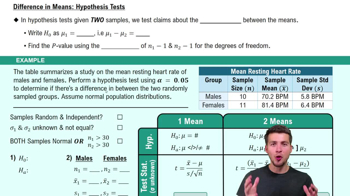
Difference in Means: Hypothesis Tests
Watch next
Master Means Unknown Equal Variances Hypothesis Test Using TI-84 with a bite sized video explanation from Patrick
Start learningRelated Videos
Related Practice
Multiple Choice
65
views
