Ch. 3 - Probability
Larson - Elementary Statistics: Picturing the World 8th Edition
Larson8th EditionElementary Statistics: Picturing the WorldISBN: 9780137493470Not the one you use?Change textbook
Chapter 3, Problem 3.2.14

Classifying Events as Independent or Dependent In Exercises 9-14, determine whether the events are independent or dependent. Explain your reasoning.
14. A ball is selected from a bin of balls numbered from 1 through 52. It is replaced, and then a second numbered ball is selected from the bin.

Verified step by step guidance
1
Understand the definition of independent and dependent events: Independent events are those where the outcome of one event does not affect the outcome of the other. Dependent events are those where the outcome of one event influences the outcome of the other.
Analyze the problem: A ball is selected from a bin of balls numbered 1 through 52, and then it is replaced before a second ball is selected. The replacement ensures that the total number of balls remains the same for both selections.
Consider the impact of replacement: Since the first ball is replaced, the probability of selecting any specific ball during the second draw remains the same as it was during the first draw. This indicates that the outcome of the first draw does not affect the second draw.
Conclude the relationship between the events: Because the replacement ensures that the conditions for the second draw are identical to the first, the two events are independent.
Explain the reasoning: The independence arises because the replacement resets the conditions, making the probability of selecting any ball during the second draw unaffected by the outcome of the first draw.

Verified video answer for a similar problem:

This video solution was recommended by our tutors as helpful for the problem above.
Video duration:
2m
Was this helpful?

Key Concepts

Here are the essential concepts you must grasp in order to answer the question correctly.

Independent Events

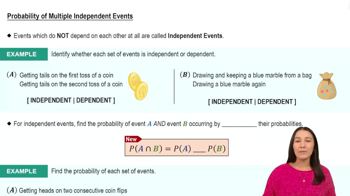
Independent events are those where the outcome of one event does not affect the outcome of another. In probability, two events A and B are independent if the probability of both occurring is the product of their individual probabilities, expressed as P(A and B) = P(A) * P(B). This concept is crucial for determining the relationship between events in probability scenarios.
Recommended video:
05:54
Probability of Multiple Independent Events

Dependent Events

Dependent events are those where the outcome of one event influences the outcome of another. For example, if the first event affects the sample space for the second event, they are considered dependent. The probability of both events occurring is calculated differently, as P(A and B) = P(A) * P(B|A), where P(B|A) is the probability of B given that A has occurred.
Recommended video:
05:54
Probability of Multiple Independent Events

Replacement in Probability

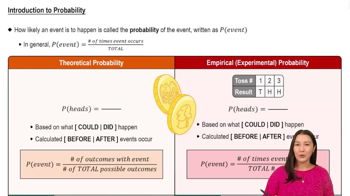
Replacement in probability refers to the practice of returning an item to the sample space after it has been selected. This action ensures that the probabilities remain constant for each selection. In the context of the given question, since the first ball is replaced before selecting the second, the events are independent, as the outcome of the first selection does not affect the second.
Recommended video:
5:37
Introduction to Probability
Related Practice
Textbook Question

Finding the Probability of an Event In Exercises 21-24, the probability that an event will not happen is given. Find the probability that the event will happen. 

21. P(E') =0.95

198
views

Textbook Question

"Classifying Events as Independent or Dependent In Exercises 9-14, determine whether the events are independent or dependent. Explain your reasoning.

9. Selecting a king from a standard deck of 52 playing cards, replacing it, and then selecting a queen from the deck"

66
views
Textbook Question

Writing In Exercises 89 and 90, write a statement that represents the complement of the probability.

90. The probability of randomly choosing a car with more than one cause for showing its "CHECK ENGINE" light from the population of vehicles showing "CHECK ENGINE" lights.

103
views
Textbook Question

Board of Directors The University of Colorado Board of Directors has 23 members. One member serves as board chair and another serves as vice chair. Given the names of the 23

board members, what is the probability of randomly selecting the name of the chair and the name of the vice chair? (Source: University of Colorado)

79
views
Textbook Question

37. Water Pollution An environmental agency is analyzing water samples from 80 lakes for pollution. Five of the lakes have dangerously high levels of dioxin. Six lakes are randomly selected from the sample. Use technology to find how many ways one polluted lake and five nonpolluted lakes can be chosen.

125
views
Textbook Question

Using a Frequency Distribution to Find Probabilities In Exercises 49-52, use the frequency distribution at the left, which shows the population of the United States by age group, to find the probability that a U.S. resident chosen at random is in the age range. (Source: U.S. Census Bureau)

52. 65 years old and older

132
views