
Ch. 3 - Probability
Larson - Elementary Statistics: Picturing the World 8th Edition
Larson8th EditionElementary Statistics: Picturing the WorldISBN: 9780137493470Not the one you use?Change textbook
Chapter 3, Problem 3.RE.19

In Exercises 19-22, determine whether the events are independent or dependent. Explain your reasoning.
19. Tossing a coin four times and getting four heads, and then tossing it a fifth time and getting a head

Verified step by step guidance
1
Understand the concept of independence: Two events are independent if the outcome of one event does not affect the outcome of the other. For example, in coin tosses, each toss is independent because the result of one toss does not influence the result of another.
Identify the events in the problem: Event A is tossing a coin four times and getting four heads. Event B is tossing the coin a fifth time and getting a head.
Analyze the relationship between the events: The outcome of the first four tosses (Event A) does not influence the outcome of the fifth toss (Event B). This is because each coin toss is a separate, independent trial with a fixed probability of heads (0.5) or tails (0.5).
Explain the reasoning: Since the probability of getting heads on the fifth toss remains 0.5 regardless of the outcomes of the previous tosses, the events are independent.
Conclude: Based on the analysis, the events are independent because the result of the fifth toss is not affected by the results of the first four tosses.

Verified video answer for a similar problem:

This video solution was recommended by our tutors as helpful for the problem above.
Video duration:
2m
Was this helpful?

Key Concepts

Here are the essential concepts you must grasp in order to answer the question correctly.

Independent Events

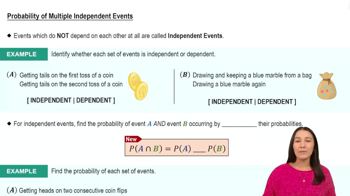
Independent events are those whose outcomes do not affect each other. In probability, two events A and B are independent if the occurrence of A does not change the likelihood of B occurring, and vice versa. For example, tossing a coin multiple times is independent because the result of one toss does not influence the results of subsequent tosses.
Recommended video:
05:54
Probability of Multiple Independent Events

Dependent Events

Dependent events are those where the outcome of one event affects the outcome of another. In probability, if the occurrence of event A changes the probability of event B occurring, then A and B are considered dependent. An example would be drawing cards from a deck without replacement, where the first draw affects the composition of the deck for the second draw.
Recommended video:
05:54
Probability of Multiple Independent Events

Probability of Coin Tosses

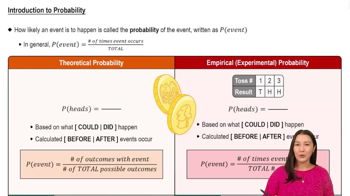
The probability of a coin toss is a fundamental concept in statistics, where each toss has two possible outcomes: heads or tails, each with a probability of 0.5. When considering multiple tosses, the outcomes remain independent, meaning the probability of getting heads on the fifth toss remains 0.5, regardless of the results of the previous tosses.
Recommended video:
5:37
Introduction to Probability