For each expression in Column I, choose the expression from Column II that completes an identity. One or both expressions may need to be rewritten. -tan x cos x
Verified step by step guidance
1
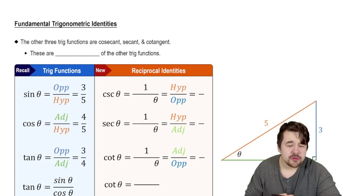
Step 1: Recall the trigonometric identity for tangent: \( \tan x = \frac{\sin x}{\cos x} \).
Step 2: Substitute \( \tan x \) in the expression \( -\tan x \cos x \) with \( \frac{\sin x}{\cos x} \).
Step 3: Simplify the expression: \( -\frac{\sin x}{\cos x} \cdot \cos x \).
Step 4: Notice that \( \cos x \) in the numerator and denominator cancels out.
Step 5: The simplified expression is \( -\sin x \), which completes the identity.
Verified video answer for a similar problem:
This video solution was recommended by our tutors as helpful for the problem above
Play a video:
Was this helpful?
Key Concepts
Here are the essential concepts you must grasp in order to answer the question correctly.
Trigonometric Identities
Trigonometric identities are equations that involve trigonometric functions and are true for all values of the variables involved. Common identities include the Pythagorean identities, reciprocal identities, and co-function identities. Understanding these identities is crucial for simplifying expressions and solving equations in trigonometry.
Rewriting trigonometric expressions involves using identities to transform one expression into another equivalent form. This process often includes substituting functions, factoring, or applying algebraic techniques to simplify or manipulate the expression. Mastery of this skill is essential for completing identities and solving trigonometric problems.
The tangent function, defined as the ratio of the sine and cosine functions (tan x = sin x / cos x), plays a significant role in trigonometry. It is important to understand its properties, such as its periodicity and asymptotes, as well as how it interacts with other trigonometric functions. This knowledge is vital for solving expressions involving tangent and completing identities.