For each expression in Column I, choose the expression from Column II that completes an identity. One or both expressions may need to be rewritten. sec x/csc x
Verified step by step guidance
1
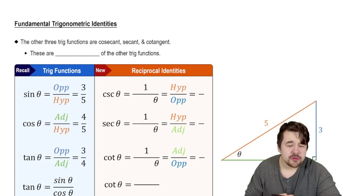
Recall the definitions of the secant and cosecant functions in terms of sine and cosine: \(\sec x = \frac{1}{\cos x}\) and \(\csc x = \frac{1}{\sin x}\).
Rewrite the given expression \(\frac{\sec x}{\csc x}\) by substituting these definitions: \(\frac{\frac{1}{\cos x}}{\frac{1}{\sin x}}\).
Simplify the complex fraction by multiplying the numerator by the reciprocal of the denominator: \(\frac{1}{\cos x} \times \frac{\sin x}{1} = \frac{\sin x}{\cos x}\).
Recognize that \(\frac{\sin x}{\cos x}\) is the definition of the tangent function, so the expression simplifies to \(\tan x\).
Therefore, the expression \(\frac{\sec x}{\csc x}\) is equivalent to \(\tan x\), completing the identity.
Verified video answer for a similar problem:
This video solution was recommended by our tutors as helpful for the problem above
Play a video:
0 Comments
Key Concepts
Here are the essential concepts you must grasp in order to answer the question correctly.
Reciprocal Trigonometric Functions
Reciprocal functions relate basic trig functions to their inverses, such as sec x = 1/cos x and csc x = 1/sin x. Understanding these allows rewriting expressions like sec x/csc x in terms of sine and cosine for simplification.
Simplification involves rewriting expressions using fundamental identities and algebraic manipulation. For example, converting sec x/csc x into (1/cos x) ÷ (1/sin x) helps reduce the expression to a simpler form like sin x/cos x.
Identities such as tan x = sin x/cos x are essential for recognizing equivalent expressions. After simplification, sec x/csc x can be identified as tan x, completing the identity by matching expressions from both columns.