Find each exact function value. See Example 2. tan 5π/6
Verified step by step guidance
1
Convert the angle from radians to degrees. Since \( \pi \) radians is equal to 180 degrees, \( \frac{5\pi}{6} \) radians is equivalent to \( \frac{5 \times 180}{6} \) degrees.
Simplify the degree measure to find that \( \frac{5\pi}{6} \) radians is equal to 150 degrees.
Recognize that 150 degrees is in the second quadrant, where the tangent function is negative.
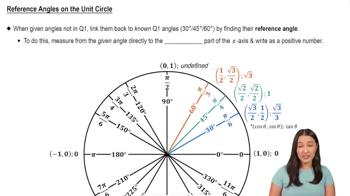
Use the reference angle for 150 degrees, which is 30 degrees, to find the tangent value. The reference angle is the acute angle that the terminal side of the given angle makes with the x-axis.
Recall that \( \tan(30^\circ) = \frac{1}{\sqrt{3}} \) or \( \tan(30^\circ) = \frac{\sqrt{3}}{3} \). Since 150 degrees is in the second quadrant, the tangent value is negative, so \( \tan(150^\circ) = -\frac{\sqrt{3}}{3} \).
Verified video answer for a similar problem:
This video solution was recommended by our tutors as helpful for the problem above
Play a video:
Was this helpful?
Key Concepts
Here are the essential concepts you must grasp in order to answer the question correctly.
Unit Circle
The unit circle is a circle with a radius of one centered at the origin of a coordinate plane. It is fundamental in trigonometry as it allows us to define the sine, cosine, and tangent functions for all angles. Each point on the unit circle corresponds to an angle and provides the coordinates (cosine, sine) for that angle, which are essential for calculating trigonometric values.
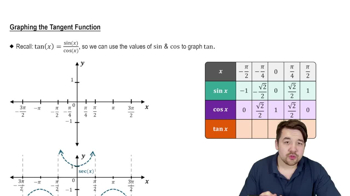
The tangent function, denoted as tan(θ), is defined as the ratio of the sine and cosine of an angle: tan(θ) = sin(θ) / cos(θ). It represents the slope of the line formed by the angle in the unit circle. Understanding how to compute the tangent of specific angles, especially those in different quadrants, is crucial for solving trigonometric problems.
A reference angle is the acute angle formed by the terminal side of an angle and the x-axis. It is used to simplify the calculation of trigonometric functions for angles greater than 90 degrees or less than 0 degrees. For example, the reference angle for 5π/6 is π/6, which helps in determining the exact values of sine, cosine, and tangent for angles in the second quadrant.