Find each exact function value. See Example 2. sec 23π/6
Verified step by step guidance
1
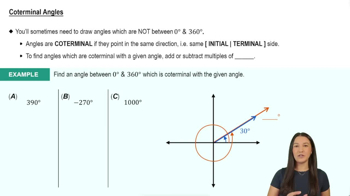
First, recognize that the angle given is \( \frac{23\pi}{6} \), which is an improper fraction greater than \( 2\pi \). To simplify, subtract multiples of \( 2\pi \) to find a coterminal angle within the interval \( [0, 2\pi) \). Since \( 2\pi = \frac{12\pi}{6} \), subtract \( 12\pi/6 \) twice: \( \frac{23\pi}{6} - 2 \times \frac{12\pi}{6} = \frac{23\pi}{6} - \frac{24\pi}{6} = -\frac{\pi}{6} \).
Because \( -\frac{\pi}{6} \) is negative, add \( 2\pi \) once to get a positive coterminal angle: \( -\frac{\pi}{6} + 2\pi = -\frac{\pi}{6} + \frac{12\pi}{6} = \frac{11\pi}{6} \). So, \( \sec \frac{23\pi}{6} = \sec \frac{11\pi}{6} \).
Recall that \( \sec \theta = \frac{1}{\cos \theta} \). Therefore, to find \( \sec \frac{11\pi}{6} \), first find \( \cos \frac{11\pi}{6} \).
Use the unit circle or cosine properties: \( \frac{11\pi}{6} \) is in the fourth quadrant, where cosine is positive. The reference angle is \( 2\pi - \frac{11\pi}{6} = \frac{\pi}{6} \). So, \( \cos \frac{11\pi}{6} = \cos \frac{\pi}{6} \).
Recall the exact value \( \cos \frac{\pi}{6} = \frac{\sqrt{3}}{2} \). Therefore, \( \sec \frac{11\pi}{6} = \frac{1}{\cos \frac{11\pi}{6}} = \frac{1}{\frac{\sqrt{3}}{2}} \).
Verified video answer for a similar problem:
This video solution was recommended by our tutors as helpful for the problem above
Play a video:
0 Comments
Key Concepts
Here are the essential concepts you must grasp in order to answer the question correctly.
Understanding the Secant Function
The secant function, sec(θ), is the reciprocal of the cosine function, defined as sec(θ) = 1/cos(θ). To find sec(θ), you first determine the cosine of the angle θ and then take its reciprocal. This relationship is fundamental when evaluating secant values exactly.
Angles greater than 2π or less than 0 can be simplified by subtracting or adding multiples of 2π to find a coterminal angle within the standard interval [0, 2π). For 23π/6, subtracting 2π (12π/6) twice reduces it to an equivalent angle, making it easier to evaluate trigonometric functions.
Exact Values of Trigonometric Functions for Special Angles
Certain angles, such as π/6, π/4, and π/3, have well-known exact trigonometric values involving square roots and fractions. Recognizing that 23π/6 reduces to a special angle allows you to use these exact values rather than decimal approximations, ensuring precise answers.

 Verified step by step guidance
 6:22
6:22