Reciprocal crosses of experimental animals or plants sometimes give different results in the F1. What are two possible genetic explanations? How would you distinguish between these two possibilities (i.e., what crosses would you perform, and what would the results tell you)?
Verified step by step guidance
1
Understand the concept of reciprocal crosses: Reciprocal crosses involve swapping the sexes of the parents in two separate crosses to determine if the inheritance pattern depends on the sex of the parent contributing a particular allele.
Identify the two possible genetic explanations for differing results in reciprocal crosses: (1) Sex-linked inheritance, where the gene is located on a sex chromosome, and (2) Maternal effect, where the phenotype of the offspring is influenced by the genotype or environment of the mother.
Design a test cross to distinguish between sex-linked inheritance and maternal effect: For sex-linked inheritance, perform a cross where the male parent carries the allele of interest and the female parent does not, and vice versa. For maternal effect, focus on the genotype of the mother and observe if the offspring's phenotype consistently matches the maternal genotype regardless of the father's genotype.
Analyze the results of the test crosses: If the inheritance pattern follows sex-linked inheritance, the offspring's phenotype will depend on the sex of the parent contributing the allele. If the maternal effect is responsible, the offspring's phenotype will consistently match the maternal genotype regardless of the father's contribution.
Confirm the hypothesis: Perform additional crosses to verify the results. For sex-linked inheritance, test for consistent patterns of inheritance tied to sex chromosomes. For maternal effect, test whether the offspring's phenotype is influenced solely by the mother's genotype or environment.
Verified video answer for a similar problem:
This video solution was recommended by our tutors as helpful for the problem above
Video duration:
2m
Play a video:
Was this helpful?
Key Concepts
Here are the essential concepts you must grasp in order to answer the question correctly.
Reciprocal Crosses
Reciprocal crosses involve mating two organisms in both possible combinations of their traits. For example, if one organism has trait A and the other has trait B, a reciprocal cross would involve crossing A with B and then B with A. This method helps to determine if the inheritance of traits is influenced by the sex of the parent, revealing potential differences in genetic contributions.
Sex-linked inheritance refers to genes located on sex chromosomes, which can lead to different expression patterns of traits based on the sex of the individual. For instance, if a trait is carried on the X chromosome, males (XY) and females (XX) may express the trait differently, leading to variations in the results of reciprocal crosses. Understanding this concept is crucial for interpreting the outcomes of genetic experiments.
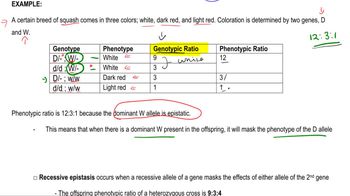
Genetic epistasis occurs when the expression of one gene is affected by one or more other genes. This interaction can lead to unexpected results in reciprocal crosses, as the presence of certain alleles may mask or modify the expression of others. To distinguish between epistasis and other genetic factors, specific crosses can be performed to analyze the phenotypic ratios and determine the underlying genetic interactions.