Reciprocal crosses of experimental animals or plants sometimes give different results in the F1. What are two possible genetic explanations? How would you distinguish between these two possibilities (i.e., what crosses would you perform, and what would the results tell you)?
Table of contents
- 1. Introduction to Genetics51m
- 2. Mendel's Laws of Inheritance3h 37m
- 3. Extensions to Mendelian Inheritance2h 41m
- 4. Genetic Mapping and Linkage2h 28m
- 5. Genetics of Bacteria and Viruses1h 21m
- 6. Chromosomal Variation1h 48m
- 7. DNA and Chromosome Structure56m
- 8. DNA Replication1h 10m
- 9. Mitosis and Meiosis1h 34m
- 10. Transcription1h 0m
- 11. Translation58m
- 12. Gene Regulation in Prokaryotes1h 19m
- 13. Gene Regulation in Eukaryotes44m
- 14. Genetic Control of Development44m
- 15. Genomes and Genomics1h 50m
- 16. Transposable Elements47m
- 17. Mutation, Repair, and Recombination1h 6m
- 18. Molecular Genetic Tools19m
- 19. Cancer Genetics29m
- 20. Quantitative Genetics1h 26m
- 21. Population Genetics50m
- 22. Evolutionary Genetics29m
2. Mendel's Laws of Inheritance
Mendel's Experiments and Laws
Problem 4
Textbook Question
Which of Mendel's postulates are illustrated by the pedigree that you constructed in Problem 3? List and define these postulates.
Verified step by step guidance1
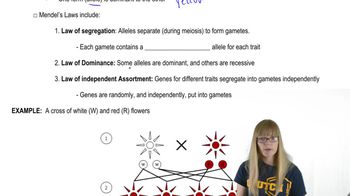
Recall Mendel's three main postulates: the Law of Segregation, the Law of Independent Assortment, and the Law of Dominance.
Examine the pedigree you constructed in Problem 3 to identify patterns of inheritance, such as whether traits appear in every generation or skip generations, and whether traits are inherited independently or together.
Determine if the Law of Segregation is illustrated by observing that each individual inherits one allele from each parent, which explains how traits can reappear after skipping a generation.
Check if the Law of Independent Assortment is demonstrated by seeing if different traits are inherited independently of each other, which would be evident if the pedigree shows no consistent linkage between traits.
Identify if the Law of Dominance applies by noting whether one trait consistently masks the presence of another in heterozygous individuals, as shown by dominant and recessive phenotypes in the pedigree.
Verified video answer for a similar problem:This video solution was recommended by our tutors as helpful for the problem above
Video duration:
3mPlay a video:
Was this helpful?
Key Concepts
Here are the essential concepts you must grasp in order to answer the question correctly.
Mendel's Law of Segregation
This postulate states that each individual has two alleles for each gene, which segregate during gamete formation so that each gamete carries only one allele. It explains how traits are inherited as discrete units and is fundamental to understanding inheritance patterns shown in pedigrees.
Recommended video:
Guided course
Mendel's Laws
Mendel's Law of Independent Assortment
This law states that alleles of different genes assort independently of one another during gamete formation. It accounts for the genetic variation seen in offspring and helps interpret how multiple traits may be inherited separately in a pedigree.
Recommended video:
Guided course
Mendel's Laws
Mendel's Concept of Dominance
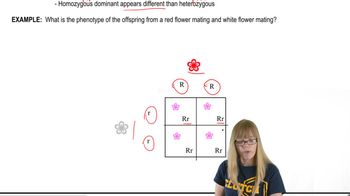
Mendel proposed that some alleles are dominant and mask the expression of recessive alleles in heterozygotes. This concept is crucial for understanding how traits appear in pedigrees, especially when dominant and recessive phenotypes are tracked across generations.
Recommended video:
Guided course
Variations on Dominance
Related Videos
Related Practice
Textbook Question
667
views
