Using sickle-cell anemia as an example, describe what is meant by a molecular or genetic disease. What are the similarities and dissimilarities between this type of a disorder and a disease caused by an invading microorganism?
Table of contents
- 1. Introduction to Genetics51m
- 2. Mendel's Laws of Inheritance3h 37m
- 3. Extensions to Mendelian Inheritance2h 41m
- 4. Genetic Mapping and Linkage2h 28m
- 5. Genetics of Bacteria and Viruses1h 21m
- 6. Chromosomal Variation1h 48m
- 7. DNA and Chromosome Structure56m
- 8. DNA Replication1h 10m
- 9. Mitosis and Meiosis1h 34m
- 10. Transcription1h 0m
- 11. Translation58m
- 12. Gene Regulation in Prokaryotes1h 19m
- 13. Gene Regulation in Eukaryotes44m
- 14. Genetic Control of Development44m
- 15. Genomes and Genomics1h 50m
- 16. Transposable Elements47m
- 17. Mutation, Repair, and Recombination1h 6m
- 18. Molecular Genetic Tools19m
- 19. Cancer Genetics29m
- 20. Quantitative Genetics1h 26m
- 21. Population Genetics50m
- 22. Evolutionary Genetics29m
11. Translation
Proteins
Problem 23
Textbook Question
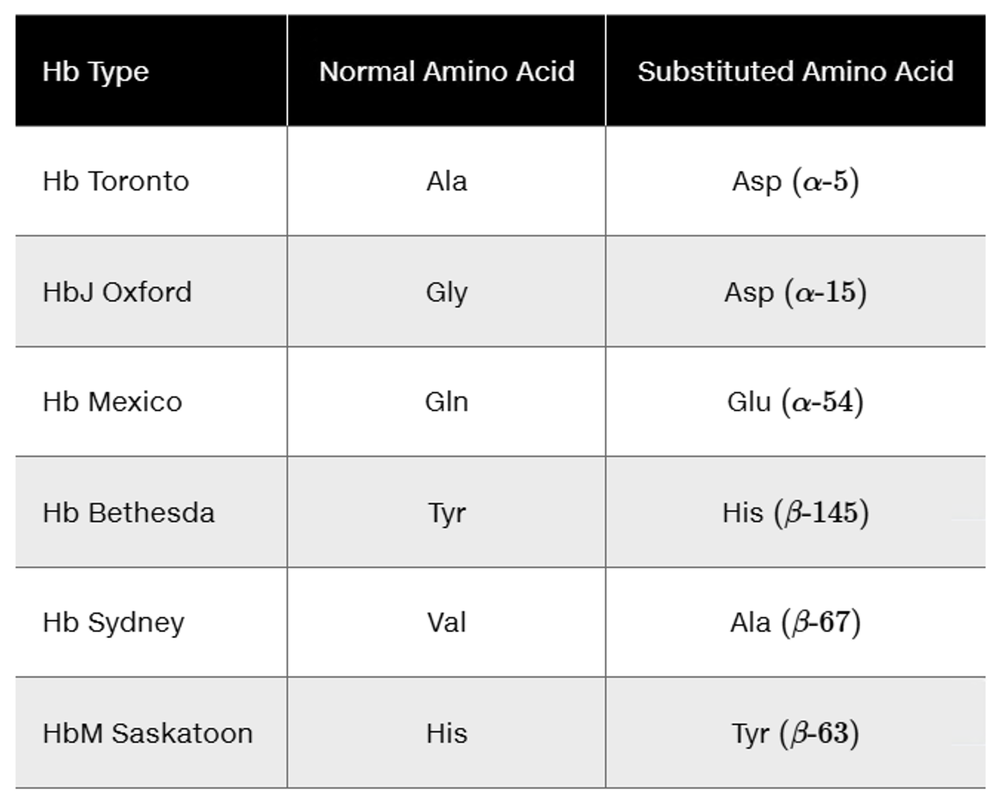
Several amino acid substitutions in the α and β chains of human hemoglobin are shown in the following table.

Using the code table, determine how many of them can occur as a result of a single-nucleotide change.
Verified step by step guidance1
Step 1: Identify the codons for the normal and substituted amino acids using the standard genetic code table. Each amino acid is encoded by one or more codons (triplets of nucleotides).
Step 2: For each hemoglobin variant, write down the codon(s) that could encode the normal amino acid and the codon(s) that could encode the substituted amino acid.
Step 3: Compare the codons for the normal and substituted amino acids to determine if the substitution can be caused by a single-nucleotide change. This means checking if changing one nucleotide in the normal codon can produce a codon for the substituted amino acid.
Step 4: Count how many of the amino acid substitutions in the table can be explained by a single-nucleotide change in the codon.
Step 5: Summarize your findings by stating the total number of substitutions that can occur due to a single-nucleotide change, based on your codon comparisons.
Verified video answer for a similar problem:This video solution was recommended by our tutors as helpful for the problem above
Video duration:
4mPlay a video:
Was this helpful?
Key Concepts
Here are the essential concepts you must grasp in order to answer the question correctly.
Genetic Code and Codon Table
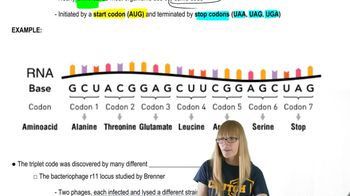
The genetic code consists of nucleotide triplets called codons, each specifying an amino acid. Understanding the codon table is essential to determine how a single-nucleotide change (point mutation) can alter a codon to code for a different amino acid, leading to amino acid substitutions in proteins.
Recommended video:
Guided course
The Genetic Code
Missense Mutations and Single-Nucleotide Changes
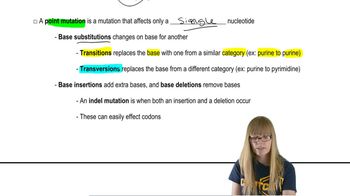
Missense mutations are point mutations where a single nucleotide change results in a codon that codes for a different amino acid. Identifying whether an amino acid substitution can arise from a single-nucleotide change requires comparing codons of the original and substituted amino acids.
Recommended video:
Guided course
Point Mutations
Hemoglobin Structure and Variants
Hemoglobin is composed of α and β chains, each with specific amino acid sequences. Variants arise from amino acid substitutions in these chains, which can affect function. Understanding the location and nature of these substitutions helps relate genetic mutations to protein changes.
Recommended video:
Guided course
Chromosome Structure
Related Videos
Related Practice
Textbook Question
712
views