A number of experiments have demonstrated that areas of the genome that are transcriptionally inactive are also resistant to DNase I digestion. However, transcriptionally active areas are DNase I sensitive. Describe how DNase I resistance or sensitivity might indicate transcriptional activity.
Table of contents
- 1. Introduction to Genetics51m
- 2. Mendel's Laws of Inheritance3h 37m
- 3. Extensions to Mendelian Inheritance2h 41m
- 4. Genetic Mapping and Linkage2h 28m
- 5. Genetics of Bacteria and Viruses1h 21m
- 6. Chromosomal Variation1h 48m
- 7. DNA and Chromosome Structure56m
- 8. DNA Replication1h 10m
- 9. Mitosis and Meiosis1h 34m
- 10. Transcription1h 0m
- 11. Translation58m
- 12. Gene Regulation in Prokaryotes1h 19m
- 13. Gene Regulation in Eukaryotes44m
- 14. Genetic Control of Development44m
- 15. Genomes and Genomics1h 50m
- 16. Transposable Elements47m
- 17. Mutation, Repair, and Recombination1h 6m
- 18. Molecular Genetic Tools19m
- 19. Cancer Genetics29m
- 20. Quantitative Genetics1h 26m
- 21. Population Genetics50m
- 22. Evolutionary Genetics29m
10. Transcription
Overview of Transcription
Problem 17
Textbook Question
Define the process of transcription. Where does this process fit into the central dogma of molecular biology (DNA makes RNA makes protein)?
Verified step by step guidance1
Begin by defining transcription as the biological process where a segment of DNA is copied into RNA by the enzyme RNA polymerase.
Explain that during transcription, the DNA double helix unwinds and one strand serves as a template for synthesizing a complementary RNA strand.
Describe that the RNA produced is messenger RNA (mRNA), which carries the genetic information from DNA to the ribosome for protein synthesis.
Place transcription within the central dogma of molecular biology by stating that it is the first step where genetic information flows from DNA to RNA.
Clarify that after transcription, the mRNA undergoes translation, where it is decoded to build proteins, completing the flow: DNA \rightarrow RNA \rightarrow Protein.
Verified video answer for a similar problem:This video solution was recommended by our tutors as helpful for the problem above
Video duration:
2mPlay a video:
Was this helpful?
Key Concepts
Here are the essential concepts you must grasp in order to answer the question correctly.
Transcription
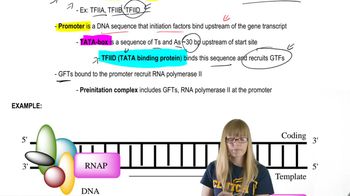
Transcription is the process by which a segment of DNA is copied into messenger RNA (mRNA) by the enzyme RNA polymerase. This occurs in the cell nucleus and serves as the first step in gene expression, converting genetic information from DNA into a form that can be translated into proteins.
Recommended video:
Guided course
Eukaryotic Transcription
Central Dogma of Molecular Biology
The central dogma describes the flow of genetic information within a biological system: DNA is transcribed into RNA, which is then translated into protein. It explains how genetic instructions are transferred and expressed, highlighting transcription as the critical link between DNA and RNA.
Recommended video:
Guided course
Mapping with Markers
Role of RNA in Protein Synthesis
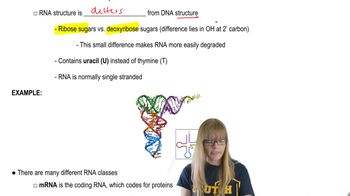
RNA acts as the intermediary molecule that carries genetic information from DNA to the ribosome, where proteins are synthesized. Messenger RNA (mRNA) produced during transcription provides the template for assembling amino acids into proteins during translation.
Recommended video:
Watch next
Master Overview of Transcription with a bite sized video explanation from Kylia
Start learningRelated Videos
Related Practice
Textbook Question
656
views