In one to two sentences each, describe the three processes that commonly modify eukaryotic pre-mRNA.
Table of contents
- 1. Introduction to Genetics51m
- 2. Mendel's Laws of Inheritance3h 37m
- 3. Extensions to Mendelian Inheritance2h 41m
- 4. Genetic Mapping and Linkage2h 28m
- 5. Genetics of Bacteria and Viruses1h 21m
- 6. Chromosomal Variation1h 48m
- 7. DNA and Chromosome Structure56m
- 8. DNA Replication1h 10m
- 9. Mitosis and Meiosis1h 34m
- 10. Transcription1h 0m
- 11. Translation58m
- 12. Gene Regulation in Prokaryotes1h 19m
- 13. Gene Regulation in Eukaryotes44m
- 14. Genetic Control of Development44m
- 15. Genomes and Genomics1h 50m
- 16. Transposable Elements47m
- 17. Mutation, Repair, and Recombination1h 6m
- 18. Molecular Genetic Tools19m
- 19. Cancer Genetics29m
- 20. Quantitative Genetics1h 26m
- 21. Population Genetics50m
- 22. Evolutionary Genetics29m
10. Transcription
Overview of Transcription
Problem 13b
Textbook Question
A short RNA molecule was isolated that demonstrated a hyperchromic shift, indicating secondary structure. Its sequence was determined to be
5'-AGGCGCCGACUCUACU-3'
What DNA sequence would give rise to this RNA molecule through transcription?
Verified step by step guidance1
Identify that the RNA sequence is synthesized from the DNA template strand during transcription, where RNA is complementary and antiparallel to the DNA template strand.
Write down the RNA sequence given: 5'-AGGCGCCGACUCUACU-3'. Since RNA is synthesized 5' to 3', the DNA template strand must be complementary and oriented 3' to 5'.
Find the complementary DNA template strand by replacing each RNA base with its DNA complement: A pairs with T, G pairs with C, C pairs with G, and U (uracil) pairs with A. Remember to reverse the direction to 3' to 5'.
Once the DNA template strand is determined (3' to 5'), write the corresponding DNA coding strand, which has the same sequence as the RNA (except T replaces U) and runs 5' to 3'.
Present the final DNA sequence (coding strand) that would give rise to the RNA molecule during transcription.
Verified video answer for a similar problem:This video solution was recommended by our tutors as helpful for the problem above
Video duration:
2mPlay a video:
Was this helpful?
Key Concepts
Here are the essential concepts you must grasp in order to answer the question correctly.
Transcription Process
Transcription is the process by which an RNA molecule is synthesized from a DNA template strand. RNA polymerase reads the DNA template strand in the 3' to 5' direction, producing a complementary RNA strand in the 5' to 3' direction. The RNA sequence is complementary to the DNA template strand and identical (except for uracil replacing thymine) to the DNA coding strand.
Recommended video:
Guided course
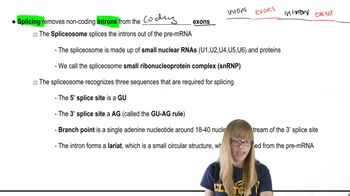
mRNA Processing
DNA and RNA Base Pairing Rules
Base pairing rules dictate that adenine (A) pairs with thymine (T) in DNA, but in RNA, adenine pairs with uracil (U). Cytosine (C) pairs with guanine (G) in both DNA and RNA. During transcription, RNA bases pair complementarily with the DNA template strand, replacing thymine with uracil in RNA.
Recommended video:
Guided course
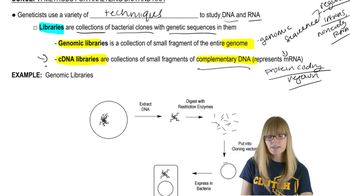
Methods for Analyzing DNA and RNA
DNA Coding and Template Strands
The DNA coding strand has the same sequence as the RNA transcript (except T is replaced by U in RNA), while the template strand is complementary to both. To find the DNA sequence that produces a given RNA, one must identify the coding strand sequence, which matches the RNA sequence with T substituted for U.
Recommended video:
Guided course
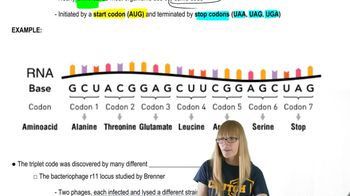
The Genetic Code
Watch next
Master Overview of Transcription with a bite sized video explanation from Kylia
Start learningRelated Videos
Related Practice
Textbook Question
551
views
