What is a gene?
Table of contents
- 1. Introduction to Genetics51m
- 2. Mendel's Laws of Inheritance3h 37m
- 3. Extensions to Mendelian Inheritance2h 41m
- 4. Genetic Mapping and Linkage2h 28m
- 5. Genetics of Bacteria and Viruses1h 21m
- 6. Chromosomal Variation1h 48m
- 7. DNA and Chromosome Structure56m
- 8. DNA Replication1h 10m
- 9. Mitosis and Meiosis1h 34m
- 10. Transcription1h 0m
- 11. Translation58m
- 12. Gene Regulation in Prokaryotes1h 19m
- 13. Gene Regulation in Eukaryotes44m
- 14. Genetic Control of Development44m
- 15. Genomes and Genomics1h 50m
- 16. Transposable Elements47m
- 17. Mutation, Repair, and Recombination1h 6m
- 18. Molecular Genetic Tools19m
- 19. Cancer Genetics29m
- 20. Quantitative Genetics1h 26m
- 21. Population Genetics50m
- 22. Evolutionary Genetics29m
10. Transcription
Overview of Transcription
Problem 11
Textbook Question
Refer to Table 13.1. Can you hypothesize why a synthetic RNA composed of a mixture of poly U poly A would not stimulate incorporation of ¹⁴C-phenylalanine into protein?
Verified step by step guidance1
Step 1: Understand the role of synthetic RNA in protein synthesis. Synthetic RNA sequences like poly U or poly A are used to test which amino acids are incorporated into proteins by ribosomes, based on the codon they represent.
Step 2: Recall that poly U RNA consists of repeating uracil nucleotides, which code for the amino acid phenylalanine (Phe) according to the genetic code. This is why poly U stimulates incorporation of ¹⁴C-phenylalanine into protein.
Step 3: Recognize that poly A RNA consists of repeating adenine nucleotides, which code for the amino acid lysine (Lys), not phenylalanine. Therefore, poly A alone would not stimulate incorporation of ¹⁴C-phenylalanine.
Step 4: Consider what happens when you mix poly U and poly A sequences. The mixture contains codons for both phenylalanine and lysine, but the presence of poly A dilutes the poly U codons, reducing the frequency of phenylalanine codons available for translation.
Step 5: Hypothesize that because the synthetic RNA is a mixture of poly U and poly A, the ribosomes encounter fewer phenylalanine codons overall, leading to a reduced or no stimulation of ¹⁴C-phenylalanine incorporation into protein.
Verified video answer for a similar problem:This video solution was recommended by our tutors as helpful for the problem above
Video duration:
1mPlay a video:
Was this helpful?
Key Concepts
Here are the essential concepts you must grasp in order to answer the question correctly.
Genetic Code and Codon Specificity
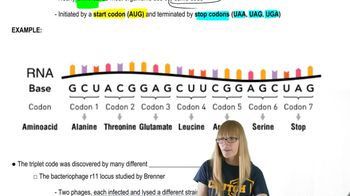
The genetic code consists of codons, three-nucleotide sequences in mRNA that specify particular amino acids. Each codon corresponds to one amino acid, so a synthetic RNA with mixed poly U and poly A sequences would produce ambiguous signals, preventing specific amino acid incorporation like phenylalanine, which is encoded by UUU or UUC codons.
Recommended video:
Guided course
The Genetic Code
Role of Synthetic RNA in In Vitro Translation
Synthetic RNA sequences are used in experiments to direct protein synthesis by ribosomes. A homopolymer like poly U directs incorporation of phenylalanine, but a mixture of poly U and poly A disrupts this specificity, leading to inefficient or no incorporation of labeled amino acids such as ¹⁴C-phenylalanine.
Recommended video:
Aminoacyl-tRNA Recognition and Codon-Anticodon Pairing
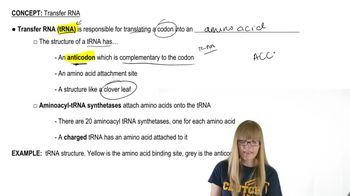
During translation, aminoacyl-tRNAs recognize specific codons via complementary anticodons, ensuring correct amino acid addition. Mixed RNA sequences interfere with proper codon-anticodon pairing, so tRNA carrying phenylalanine cannot bind effectively, preventing its incorporation into the growing polypeptide chain.
Recommended video:
Watch next
Master Overview of Transcription with a bite sized video explanation from Kylia
Start learningRelated Videos
Related Practice
Textbook Question
1042
views
