Researchers interested in studying mutation and mutation repair often induce mutations with various agents. What kinds of gene mutations are induced by Chemical mutagens? Give two examples.
Verified step by step guidance
1
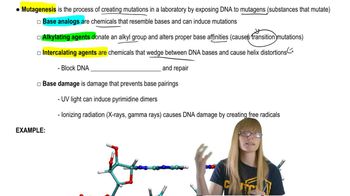
Understand that chemical mutagens are agents that can alter the DNA sequence, leading to gene mutations. These mutations can affect the structure or function of proteins encoded by the genes.
Learn about the types of gene mutations induced by chemical mutagens. Common types include point mutations (substitution of a single nucleotide) and frameshift mutations (insertion or deletion of nucleotides that disrupt the reading frame).
Explore examples of chemical mutagens. One example is nitrous acid, which causes deamination of bases like cytosine, leading to point mutations. Another example is ethidium bromide, which intercalates into DNA and can cause frameshift mutations.
Understand the mechanism of action for each example. For instance, nitrous acid converts cytosine to uracil, which pairs with adenine instead of guanine during replication, resulting in a transition mutation. Ethidium bromide distorts the DNA structure, leading to errors during replication.
Recognize the importance of studying these mutations. Chemical mutagens are used in research to understand DNA repair mechanisms and the effects of mutations on gene function, which can provide insights into genetic diseases and cancer.
Verified video answer for a similar problem:
This video solution was recommended by our tutors as helpful for the problem above
Video duration:
2m
Play a video:
Was this helpful?
Key Concepts
Here are the essential concepts you must grasp in order to answer the question correctly.
Chemical Mutagens
Chemical mutagens are substances that can cause changes in the DNA sequence of an organism. They can alter the structure of DNA, leading to mutations during DNA replication. Common types of chemical mutagens include base analogs, which mimic normal DNA bases, and alkylating agents, which add alkyl groups to DNA, disrupting normal base pairing.
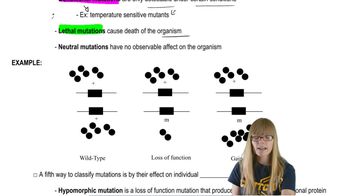
Gene mutations can be classified into several types, including point mutations, insertions, and deletions. Point mutations involve a change in a single nucleotide, which can result in silent, missense, or nonsense mutations. Insertions and deletions involve the addition or loss of nucleotides, potentially leading to frameshift mutations that alter the reading frame of the gene.
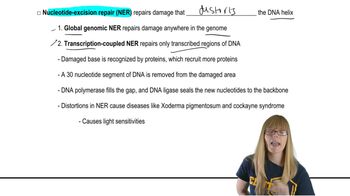
Cells have evolved various mechanisms to repair mutations, ensuring genomic stability. These include direct repair, base excision repair, and nucleotide excision repair. These processes recognize and correct damaged DNA, preventing the propagation of mutations that could lead to diseases such as cancer.