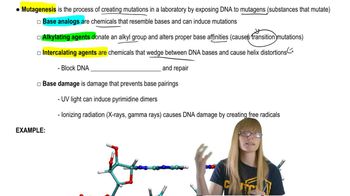
Contrast and compare the mutagenic effects of deaminating agents, alkylating agents, and base analogs.
Verified step by step guidance
1
Step 1: Define each type of mutagenic agent to understand their basic nature. Deaminating agents remove amino groups from bases, alkylating agents add alkyl groups to bases, and base analogs are structurally similar to normal bases but can be incorporated into DNA during replication.
Step 2: Explain the mechanism of mutagenesis for deaminating agents. They typically convert cytosine to uracil by removing an amino group, which can lead to a C:G to T:A transition mutation during DNA replication.
Step 3: Describe how alkylating agents cause mutations. They add alkyl groups (like methyl or ethyl) to bases, which can mispair during replication, often resulting in base substitutions or even DNA strand breaks.
Step 4: Discuss the role of base analogs. Because they resemble normal bases, they can be incorporated into DNA in place of the usual bases, but they often pair incorrectly, leading to point mutations during subsequent rounds of replication.
Step 5: Compare and contrast the effects by highlighting that deaminating agents cause specific base changes through chemical modification, alkylating agents cause a broader range of mutations by altering base pairing properties, and base analogs cause mutations by mimicking bases but pairing incorrectly, emphasizing their different mutagenic pathways.
Verified video answer for a similar problem:
This video solution was recommended by our tutors as helpful for the problem above
Video duration:
1m
Play a video:
Was this helpful?
Key Concepts
Here are the essential concepts you must grasp in order to answer the question correctly.
Deaminating Agents
Deaminating agents cause mutations by removing amino groups from nucleotide bases, often converting cytosine to uracil or adenine to hypoxanthine. This alteration leads to incorrect base pairing during DNA replication, resulting in point mutations such as transitions.
Alkylating agents add alkyl groups to DNA bases, which can cause mispairing or strand breaks. These modifications often result in base substitutions or cross-linking, disrupting normal DNA replication and leading to mutations or cytotoxicity.
Base analogs are structurally similar to normal bases but differ slightly, allowing them to be incorporated into DNA during replication. Their presence can cause mispairing or increased mutation rates because they pair incorrectly or undergo tautomeric shifts.