What are the exceptions to the general rule that DNA is the genetic material in all organisms? What evidence supports these exceptions?
Table of contents
- 1. Introduction to Genetics51m
- 2. Mendel's Laws of Inheritance3h 37m
- 3. Extensions to Mendelian Inheritance2h 41m
- 4. Genetic Mapping and Linkage2h 28m
- 5. Genetics of Bacteria and Viruses1h 21m
- 6. Chromosomal Variation1h 48m
- 7. DNA and Chromosome Structure56m
- 8. DNA Replication1h 10m
- 9. Mitosis and Meiosis1h 34m
- 10. Transcription1h 0m
- 11. Translation58m
- 12. Gene Regulation in Prokaryotes1h 19m
- 13. Gene Regulation in Eukaryotes44m
- 14. Genetic Control of Development44m
- 15. Genomes and Genomics1h 50m
- 16. Transposable Elements47m
- 17. Mutation, Repair, and Recombination1h 6m
- 18. Molecular Genetic Tools19m
- 19. Cancer Genetics29m
- 20. Quantitative Genetics1h 26m
- 21. Population Genetics50m
- 22. Evolutionary Genetics29m
7. DNA and Chromosome Structure
DNA as the Genetic Material
Problem 21
Textbook Question
What is the physical state of DNA after it is heated and denatured?
Verified step by step guidance1
Understand that DNA is composed of two complementary strands held together by hydrogen bonds between base pairs.
Recognize that heating DNA provides energy to break these hydrogen bonds, causing the two strands to separate, a process known as denaturation.
Note that after denaturation, the DNA exists as single-stranded molecules rather than the original double helix.
Realize that this single-stranded DNA is still physically present in solution but no longer maintains the double helical structure.
Conclude that the physical state of DNA after heating and denaturation is single-stranded DNA, which is more flexible and lacks the stable double helix conformation.
Verified video answer for a similar problem:This video solution was recommended by our tutors as helpful for the problem above
Video duration:
2mPlay a video:
Was this helpful?
Key Concepts
Here are the essential concepts you must grasp in order to answer the question correctly.
DNA Denaturation
DNA denaturation refers to the process where the double-stranded DNA molecule separates into two single strands due to the breaking of hydrogen bonds between complementary bases, typically caused by heat or chemical agents.
Recommended video:
Guided course
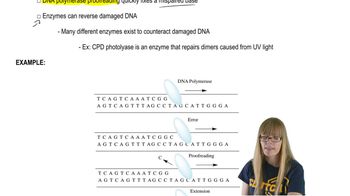
DNA Proofreading
Physical State of Single-Stranded DNA
After denaturation, DNA exists as single-stranded molecules that are more flexible and less ordered than the original double helix, losing the stable, compact structure and becoming more extended in solution.
Recommended video:
Guided course
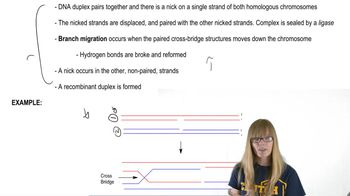
Recombination after Single Strand Breaks
Reversibility of DNA Denaturation
DNA denaturation is often reversible; upon cooling, complementary single strands can re-anneal or renature, reforming the double helix, which is important for processes like PCR and molecular biology techniques.
Recommended video:
Guided course
DNA Proofreading
Watch next
Master History and Experiments with a bite sized video explanation from Kylia
Start learningRelated Videos
Related Practice
Textbook Question
838
views