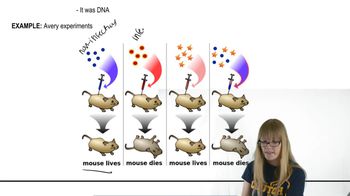
Given the state of knowledge at the time of the Avery, MacLeod, and McCarty experiment, why was it difficult for some scientists to accept that DNA is the carrier of genetic information?
Table of contents
- 1. Introduction to Genetics51m
- 2. Mendel's Laws of Inheritance3h 37m
- 3. Extensions to Mendelian Inheritance2h 41m
- 4. Genetic Mapping and Linkage2h 28m
- 5. Genetics of Bacteria and Viruses1h 21m
- 6. Chromosomal Variation1h 48m
- 7. DNA and Chromosome Structure56m
- 8. DNA Replication1h 10m
- 9. Mitosis and Meiosis1h 34m
- 10. Transcription1h 0m
- 11. Translation58m
- 12. Gene Regulation in Prokaryotes1h 19m
- 13. Gene Regulation in Eukaryotes44m
- 14. Genetic Control of Development44m
- 15. Genomes and Genomics1h 50m
- 16. Transposable Elements47m
- 17. Mutation, Repair, and Recombination1h 6m
- 18. Molecular Genetic Tools19m
- 19. Cancer Genetics29m
- 20. Quantitative Genetics1h 26m
- 21. Population Genetics50m
- 22. Evolutionary Genetics29m
7. DNA and Chromosome Structure
DNA as the Genetic Material
Problem 9
Textbook Question
What are the exceptions to the general rule that DNA is the genetic material in all organisms? What evidence supports these exceptions?
Verified step by step guidance1
Step 1: Understand the general rule that DNA is the genetic material in most organisms, meaning DNA carries the genetic information necessary for inheritance and cellular function.
Step 2: Identify the main exceptions to this rule, which are certain viruses that use RNA instead of DNA as their genetic material. Examples include retroviruses like HIV and some single-stranded RNA viruses.
Step 3: Explain that in these RNA viruses, RNA carries the genetic information and directs the synthesis of viral proteins, effectively functioning as the genetic material.
Step 4: Discuss the key experimental evidence supporting these exceptions, such as the Hershey-Chase experiment that confirmed DNA as genetic material in most organisms, and the discovery of RNA viruses where RNA was shown to be infectious and capable of replication.
Step 5: Highlight additional evidence from experiments with retroviruses, where reverse transcriptase enzyme converts viral RNA into DNA inside host cells, demonstrating RNA's role as genetic material in these cases.
Verified video answer for a similar problem:This video solution was recommended by our tutors as helpful for the problem above
Video duration:
3mPlay a video:
Was this helpful?
Key Concepts
Here are the essential concepts you must grasp in order to answer the question correctly.
DNA as the Genetic Material
DNA is the molecule that stores genetic information in most organisms, directing development and cellular functions. This concept is foundational in genetics, as DNA's structure and replication explain heredity. The general rule states that DNA carries the genetic code in all living cells.
Recommended video:
Guided course
History and Experiments
RNA as Genetic Material in Some Viruses
Certain viruses use RNA instead of DNA to store genetic information, making RNA their genetic material. Examples include retroviruses like HIV and single-stranded RNA viruses like influenza. This exception challenges the universality of DNA as genetic material and highlights RNA's role in heredity.
Recommended video:
Guided course
History and Experiments
Experimental Evidence Supporting RNA as Genetic Material
Experiments such as the Hershey-Chase experiment and studies on RNA viruses demonstrated that RNA can carry genetic information. For instance, the Hershey-Chase experiment showed that DNA, not protein, is genetic material in bacteriophages, while other research confirmed RNA's role in viral replication, supporting exceptions to the DNA rule.
Recommended video:
Guided course
History and Experiments
Watch next
Master History and Experiments with a bite sized video explanation from Kylia
Start learningRelated Videos
Related Practice
Textbook Question
886
views