Suppose the length of maize ears has narrow sense heritability (h²) of 0.70. A population produces ears that have an average length of 28 cm, and from this population a breeder selects a plant producing 34-cm ears to cross by self-fertilization. Predict the selection differential (S) and the response to selection (R) for this cross.
Table of contents
- 1. Introduction to Genetics51m
- 2. Mendel's Laws of Inheritance3h 37m
- 3. Extensions to Mendelian Inheritance2h 41m
- 4. Genetic Mapping and Linkage2h 28m
- 5. Genetics of Bacteria and Viruses1h 21m
- 6. Chromosomal Variation1h 48m
- 7. DNA and Chromosome Structure56m
- 8. DNA Replication1h 10m
- 9. Mitosis and Meiosis1h 34m
- 10. Transcription1h 0m
- 11. Translation58m
- 12. Gene Regulation in Prokaryotes1h 19m
- 13. Gene Regulation in Eukaryotes44m
- 14. Genetic Control of Development44m
- 15. Genomes and Genomics1h 50m
- 16. Transposable Elements47m
- 17. Mutation, Repair, and Recombination1h 6m
- 18. Molecular Genetic Tools19m
- 19. Cancer Genetics29m
- 20. Quantitative Genetics1h 26m
- 21. Population Genetics50m
- 22. Evolutionary Genetics29m
20. Quantitative Genetics
Heritability
Problem 17
Textbook Question
Suppose you want to develop a population of Drosophila that would rapidly learn to avoid certain substances the flies could detect by smell. Based on the heritability estimate you obtained in Problem 16, do you think it would be worth doing this by artificial selection? Why or why not?
Verified step by step guidance1
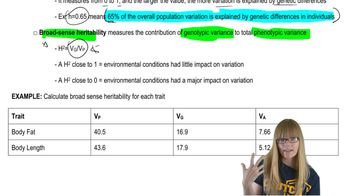
Recall that heritability (denoted as \(h^2\)) measures the proportion of phenotypic variation in a trait that is due to genetic variation within a population. It ranges from 0 to 1, where values closer to 1 indicate a strong genetic influence.
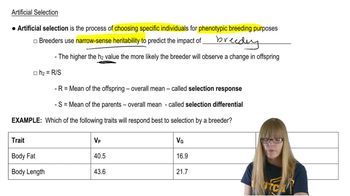
Understand that the response to artificial selection depends on the heritability of the trait. The higher the heritability, the more effective artificial selection will be in changing the trait in subsequent generations.
Use the breeder's equation to predict the response to selection: \(R = h^2 \times S\), where \(R\) is the response to selection (change in the trait mean), \(h^2\) is the heritability, and \(S\) is the selection differential (difference between the mean of selected parents and the population mean).
Evaluate the heritability estimate obtained in Problem 16. If \(h^2\) is high (close to 1), artificial selection is likely to be effective in rapidly increasing the flies' ability to learn to avoid certain substances. If \(h^2\) is low (close to 0), the trait is mostly influenced by environmental factors, and artificial selection will have little effect.
Conclude whether it is worth pursuing artificial selection based on the magnitude of \(h^2\). A high heritability suggests it is worth doing, while a low heritability suggests it may not be an efficient approach.
Verified video answer for a similar problem:This video solution was recommended by our tutors as helpful for the problem above
Video duration:
4mPlay a video:
Was this helpful?
Key Concepts
Here are the essential concepts you must grasp in order to answer the question correctly.
Heritability
Heritability measures the proportion of phenotypic variation in a trait that is due to genetic differences among individuals in a population. It ranges from 0 to 1, where higher values indicate that genetics strongly influence the trait, making it more responsive to selection.
Recommended video:
Guided course
Calculating Heritability
Artificial Selection
Artificial selection is the intentional breeding of organisms with desirable traits to enhance those traits in future generations. Its effectiveness depends on the genetic basis of the trait and the heritability, as traits with low heritability respond poorly to selection.
Recommended video:
Guided course
Artificial Selection
Behavioral Genetics in Drosophila
Behavioral genetics studies how genes influence behavior, such as olfactory learning in Drosophila. Understanding the genetic contribution to learning ability is crucial to predict if selective breeding can improve avoidance of certain smells.
Recommended video:
Guided course
Descriptive Genetics
Watch next
Master Calculating Heritability with a bite sized video explanation from Kylia
Start learningRelated Videos
Related Practice
Textbook Question
387
views
