Methylation of H3K9 by itself silences genes, but if H3K4 and H4K20 are also methylated, the combination of modifications stimulates transcription. What conclusions can you draw about this?
Verified step by step guidance
1
Understand that histone modifications, such as methylation at specific lysine residues (e.g., H3K9, H3K4, H4K20), can influence gene expression by altering chromatin structure and accessibility.
Recognize that methylation of H3K9 alone is associated with gene silencing because it promotes a more condensed chromatin state, preventing transcription machinery from accessing DNA.
Note that when H3K4 and H4K20 are also methylated along with H3K9, the combined effect changes, leading to stimulation of transcription, indicating that the context and combination of histone marks are crucial.
Conclude that histone modifications act in a combinatorial manner, where the presence of multiple marks can override or modify the effect of a single mark, demonstrating the complexity of epigenetic regulation.
Understand that this suggests a regulatory mechanism where gene expression is not controlled by a single modification but by the interplay of multiple histone marks, highlighting the importance of the histone code hypothesis.
Verified video answer for a similar problem:
This video solution was recommended by our tutors as helpful for the problem above
Video duration:
1m
Play a video:
Was this helpful?
Key Concepts
Here are the essential concepts you must grasp in order to answer the question correctly.
Histone Modifications and Gene Regulation
Histone proteins can be chemically modified, such as by methylation, which affects how tightly DNA is wrapped around them. These modifications influence gene expression by either promoting or repressing transcription, depending on the type and location of the modification.
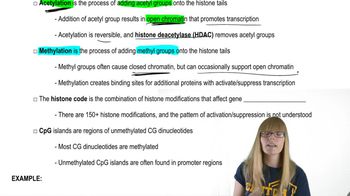
The histone code hypothesis suggests that specific combinations of histone modifications work together to regulate gene activity. For example, while methylation of H3K9 alone may silence genes, the presence of additional methylations at H3K4 and H4K20 can alter this effect, demonstrating that multiple marks integrate to determine transcriptional outcomes.
The impact of histone methylation depends on the residue modified and the presence of other modifications. Methylation at H3K9 is generally repressive, but when combined with methylation at H3K4 and H4K20, it can lead to gene activation, highlighting that histone marks do not act in isolation but in a context-dependent manner.