Consider the case where a mutation occurs that disrupts translation in a single human mitochondrion found in the oocyte participating in fertilization. What is the likely impact of this mutation on the offspring arising from this oocyte?
Table of contents
- 1. Introduction to Genetics51m
- 2. Mendel's Laws of Inheritance3h 37m
- 3. Extensions to Mendelian Inheritance2h 41m
- 4. Genetic Mapping and Linkage2h 28m
- 5. Genetics of Bacteria and Viruses1h 21m
- 6. Chromosomal Variation1h 48m
- 7. DNA and Chromosome Structure56m
- 8. DNA Replication1h 10m
- 9. Mitosis and Meiosis1h 34m
- 10. Transcription1h 0m
- 11. Translation58m
- 12. Gene Regulation in Prokaryotes1h 19m
- 13. Gene Regulation in Eukaryotes44m
- 14. Genetic Control of Development44m
- 15. Genomes and Genomics1h 50m
- 16. Transposable Elements47m
- 17. Mutation, Repair, and Recombination1h 6m
- 18. Molecular Genetic Tools19m
- 19. Cancer Genetics29m
- 20. Quantitative Genetics1h 26m
- 21. Population Genetics50m
- 22. Evolutionary Genetics29m
3. Extensions to Mendelian Inheritance
Sex Chromosome
Problem 20
Textbook Question
Cat breeders are aware that kittens expressing the X-linked calico coat pattern and tortoiseshell pattern are almost invariably females. Why are they certain of this?
Verified step by step guidance1
Understand that the calico and tortoiseshell coat patterns in cats are linked to genes located on the X chromosome, making these traits X-linked.
Recall that female cats have two X chromosomes (XX), while male cats have one X and one Y chromosome (XY).
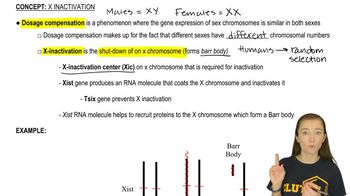
Recognize that the calico and tortoiseshell patterns result from X chromosome inactivation, where different X chromosomes are randomly silenced in different cells, leading to patches of different colors.
Since males have only one X chromosome, they cannot exhibit the patchy coat pattern caused by X-inactivation; they will express only the color encoded by their single X chromosome.
Therefore, only females, with two X chromosomes, can show the mosaic pattern of calico or tortoiseshell coats, which is why breeders are certain that cats with these patterns are almost always female.
Verified video answer for a similar problem:This video solution was recommended by our tutors as helpful for the problem above
Video duration:
3mPlay a video:
Was this helpful?
Key Concepts
Here are the essential concepts you must grasp in order to answer the question correctly.
X-linked Inheritance
X-linked inheritance refers to genes located on the X chromosome. Since males have one X and one Y chromosome, they express traits from their single X chromosome, while females have two X chromosomes, allowing for different patterns of gene expression, especially for traits linked to the X chromosome.
Recommended video:
Guided course
X-Inactivation
X-Chromosome Inactivation (Lyonization)
In female mammals, one of the two X chromosomes in each cell is randomly inactivated to balance gene dosage with males. This process creates a mosaic pattern of gene expression, which in cats leads to the patchy coat colors seen in calico and tortoiseshell females.
Recommended video:
Guided course
X-Inactivation
Genetics of Coat Color in Cats
The calico and tortoiseshell coat patterns result from different alleles of a gene on the X chromosome controlling fur color. Because males have only one X chromosome, they typically show only one color, while females can display both colors due to having two X chromosomes and X-inactivation.
Recommended video:
Guided course
Descriptive Genetics
Related Videos
Related Practice
Textbook Question
462
views