Which of the following parents could produce offspring with an AB blood type?
Table of contents
- 1. Introduction to Genetics51m
- 2. Mendel's Laws of Inheritance3h 37m
- 3. Extensions to Mendelian Inheritance2h 41m
- 4. Genetic Mapping and Linkage2h 28m
- 5. Genetics of Bacteria and Viruses1h 21m
- 6. Chromosomal Variation1h 48m
- 7. DNA and Chromosome Structure56m
- 8. DNA Replication1h 10m
- 9. Mitosis and Meiosis1h 34m
- 10. Transcription1h 0m
- 11. Translation58m
- 12. Gene Regulation in Prokaryotes1h 19m
- 13. Gene Regulation in Eukaryotes44m
- 14. Genetic Control of Development44m
- 15. Genomes and Genomics1h 50m
- 16. Transposable Elements47m
- 17. Mutation, Repair, and Recombination1h 6m
- 18. Molecular Genetic Tools19m
- 19. Cancer Genetics29m
- 20. Quantitative Genetics1h 26m
- 21. Population Genetics50m
- 22. Evolutionary Genetics29m
3. Extensions to Mendelian Inheritance
Variations of Dominance
Problem 4
Textbook Question
In foxes, two alleles of a single gene, P and p, may result in lethality (PP), platinum coat (Pp), or silver coat (pp). What ratio is obtained when platinum foxes are interbred? Is the P allele behaving dominantly or recessively in causing (a) lethality; (b) platinum coat color?
Verified step by step guidance1
Identify the genotypes and their associated phenotypes: PP results in lethality, Pp results in platinum coat, and pp results in silver coat.
Set up a Punnett square for the cross between two platinum foxes, both with genotype Pp.
Fill in the Punnett square to find the genotypic ratios of the offspring: PP, Pp, and pp.
Translate the genotypic ratios into phenotypic ratios, considering that PP individuals are lethal and will not survive.
Analyze the phenotypic outcomes to determine if the P allele is dominant or recessive for (a) lethality and (b) platinum coat color by observing which phenotypes appear in heterozygotes.
Verified video answer for a similar problem:This video solution was recommended by our tutors as helpful for the problem above
Video duration:
1mPlay a video:
Was this helpful?
Key Concepts
Here are the essential concepts you must grasp in order to answer the question correctly.
Mendelian Inheritance and Allele Interactions
Mendelian inheritance describes how alleles segregate and assort during reproduction, producing predictable genotype and phenotype ratios. Understanding dominant, recessive, and lethal alleles helps explain how different allele combinations affect traits and survival, such as when homozygous genotypes cause lethality.
Recommended video:
Guided course
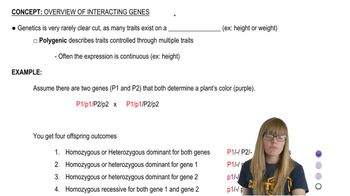
Interacting Genes Overview
Lethal Alleles and Their Effects
Lethal alleles cause death when present in certain genotypes, often homozygous. They reduce or eliminate specific genotypes from offspring ratios, altering expected Mendelian ratios. Recognizing lethality is crucial to interpreting deviations in phenotypic ratios from typical dominant-recessive patterns.
Recommended video:
Guided course
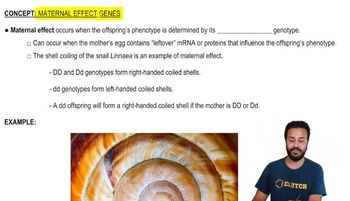
Maternal Effect
Dominance Relationships in Phenotypic Expression
Dominance refers to how one allele masks the effect of another in heterozygotes. An allele is dominant if it determines the phenotype when present, and recessive if its effect appears only in homozygotes. Determining dominance for traits like coat color or lethality involves analyzing offspring phenotypes from specific crosses.
Recommended video:
Guided course
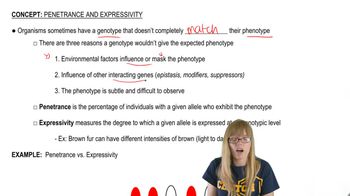
Penetrance and Expressivity
Watch next
Master Variations on Dominance with a bite sized video explanation from Kylia
Start learningRelated Videos
Related Practice
Multiple Choice
596
views
2
rank
