What is meant by the term chromatin remodeling? Describe the importance of this process to transcription.
Verified step by step guidance
1
Define chromatin remodeling as the dynamic modification of chromatin architecture to allow access of condensed genomic DNA to the regulatory transcription machinery proteins, thereby controlling gene expression.
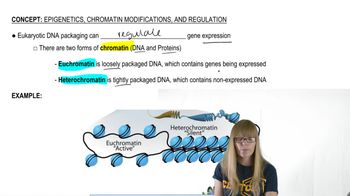
Explain that chromatin is composed of DNA wrapped around histone proteins forming nucleosomes, which can be tightly packed (heterochromatin) or loosely packed (euchromatin).
Describe how chromatin remodeling involves chemical modifications (such as acetylation, methylation) of histones or ATP-dependent repositioning of nucleosomes to change chromatin structure.
Discuss the importance of chromatin remodeling in transcription by highlighting that it regulates the accessibility of transcription factors and RNA polymerase to DNA, enabling or restricting gene expression.
Emphasize that without chromatin remodeling, genes in tightly packed chromatin would remain inaccessible, preventing transcription and proper cellular function.
Verified video answer for a similar problem:
This video solution was recommended by our tutors as helpful for the problem above
Video duration:
2m
Play a video:
Was this helpful?
Key Concepts
Here are the essential concepts you must grasp in order to answer the question correctly.
Chromatin Structure
Chromatin is the complex of DNA and proteins, mainly histones, that package DNA into a compact, organized form within the nucleus. Its structure can be tightly packed (heterochromatin) or loosely packed (euchromatin), influencing gene accessibility and expression.
Chromatin remodeling refers to dynamic modifications of chromatin architecture that alter nucleosome positioning or composition. This process makes specific DNA regions more or less accessible to transcription factors and RNA polymerase, thereby regulating gene expression.
Chromatin remodeling is crucial for transcription because it enables the transcription machinery to access DNA sequences. By loosening chromatin structure, remodeling facilitates the binding of transcription factors and RNA polymerase, initiating and regulating gene expression.