How can you tell if two genes are epistatic?
Table of contents
- 1. Introduction to Genetics51m
- 2. Mendel's Laws of Inheritance3h 37m
- 3. Extensions to Mendelian Inheritance2h 41m
- 4. Genetic Mapping and Linkage2h 28m
- 5. Genetics of Bacteria and Viruses1h 21m
- 6. Chromosomal Variation1h 48m
- 7. DNA and Chromosome Structure56m
- 8. DNA Replication1h 10m
- 9. Mitosis and Meiosis1h 34m
- 10. Transcription1h 0m
- 11. Translation58m
- 12. Gene Regulation in Prokaryotes1h 19m
- 13. Gene Regulation in Eukaryotes44m
- 14. Genetic Control of Development44m
- 15. Genomes and Genomics1h 50m
- 16. Transposable Elements47m
- 17. Mutation, Repair, and Recombination1h 6m
- 18. Molecular Genetic Tools19m
- 19. Cancer Genetics29m
- 20. Quantitative Genetics1h 26m
- 21. Population Genetics50m
- 22. Evolutionary Genetics29m
3. Extensions to Mendelian Inheritance
Epistasis and Complementation
Problem 1b
Textbook Question
In the discussion, we focused on extensions and modifications of Mendelian principles and ratios. In the process, we encountered many opportunities to consider how this information was acquired. On the basis of these discussions, what answers would you propose to the following fundamental questions?
How did geneticists determine that inheritance of some phenotypic characteristics involves the interactions of two or more gene pairs? How were they able to determine how many gene pairs were involved?
Verified step by step guidance1
Start by understanding that classical Mendelian genetics initially focused on traits controlled by a single gene pair, which showed clear dominant and recessive patterns. However, some traits did not follow these simple ratios, suggesting more complex inheritance.
Geneticists observed deviations from Mendelian ratios (such as 9:3:3:1 in dihybrid crosses) in offspring phenotypes, indicating that multiple gene pairs might interact to produce a trait. They used controlled breeding experiments to track these patterns across generations.
To determine the number of gene pairs involved, geneticists performed dihybrid and multihybrid crosses, analyzing the phenotypic ratios of offspring. By comparing observed ratios to expected Mendelian ratios, they inferred the minimum number of gene pairs influencing the trait.
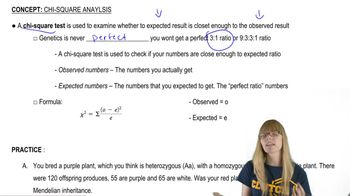
They also used statistical methods, such as the chi-square test, to assess how well the observed data fit expected ratios for different numbers of gene pairs, helping to confirm the involvement of multiple genes.
Finally, geneticists employed techniques like test crosses and pedigree analysis to further dissect gene interactions, including epistasis and polygenic inheritance, which clarified how multiple gene pairs contribute to phenotypic characteristics.
Verified video answer for a similar problem:This video solution was recommended by our tutors as helpful for the problem above
Video duration:
2mPlay a video:
Was this helpful?
Key Concepts
Here are the essential concepts you must grasp in order to answer the question correctly.
Extensions of Mendelian Inheritance
Mendelian inheritance describes traits controlled by single gene pairs with clear dominant and recessive alleles. Extensions include interactions like epistasis, incomplete dominance, and polygenic inheritance, where multiple gene pairs influence a phenotype, leading to modified phenotypic ratios beyond classic Mendelian patterns.
Recommended video:
Guided course
Organelle Inheritance
Genetic Analysis through Phenotypic Ratios
Geneticists use observed phenotypic ratios from controlled crosses to infer gene interactions. Deviations from expected Mendelian ratios suggest multiple gene pairs or gene interactions, allowing researchers to hypothesize the number and nature of genes involved in trait inheritance.
Recommended video:
Guided course
Chi Square Analysis
Complementation and Test Crosses
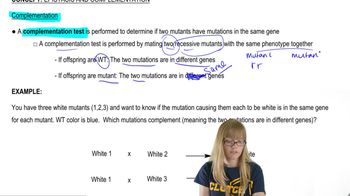
Complementation tests and test crosses help determine if different mutations affect the same gene or different genes. By analyzing offspring phenotypes from these crosses, geneticists can identify the number of gene pairs involved and how they interact to produce a phenotype.
Recommended video:
Guided course
Complementation
Related Videos
Related Practice
Multiple Choice
992
views
1
rank
1
comments