Table of contents
- 1. Introduction to Genetics51m
- 2. Mendel's Laws of Inheritance3h 37m
- 3. Extensions to Mendelian Inheritance2h 41m
- 4. Genetic Mapping and Linkage2h 28m
- 5. Genetics of Bacteria and Viruses1h 21m
- 6. Chromosomal Variation1h 48m
- 7. DNA and Chromosome Structure56m
- 8. DNA Replication1h 10m
- 9. Mitosis and Meiosis1h 34m
- 10. Transcription1h 0m
- 11. Translation58m
- 12. Gene Regulation in Prokaryotes1h 19m
- 13. Gene Regulation in Eukaryotes44m
- 14. Genetic Control of Development44m
- 15. Genomes and Genomics1h 50m
- 16. Transposable Elements47m
- 17. Mutation, Repair, and Recombination1h 6m
- 18. Molecular Genetic Tools19m
- 19. Cancer Genetics29m
- 20. Quantitative Genetics1h 26m
- 21. Population Genetics50m
- 22. Evolutionary Genetics29m
6. Chromosomal Variation
Chromosomal Mutations: Aneuploidy
Problem 9
Textbook Question
Describe how nondisjunction in human female gametes can give rise to Klinefelter and Turner syndrome offspring following fertilization by a normal male gamete.
Verified step by step guidance1
Understand that nondisjunction is the failure of chromosome pairs to separate properly during meiosis, resulting in gametes with abnormal numbers of chromosomes.
Recognize that in human females, nondisjunction can occur during meiosis I or II, leading to eggs that either have two X chromosomes (XX) or no sex chromosome (O).
Consider fertilization by a normal male gamete, which always contributes one X or one Y chromosome.
For Klinefelter syndrome (typically XXY), an egg with two X chromosomes (due to nondisjunction) is fertilized by a sperm carrying a Y chromosome, resulting in an XXY zygote.
For Turner syndrome (typically XO), an egg with no sex chromosome (due to nondisjunction) is fertilized by a sperm carrying an X chromosome, resulting in an XO zygote.
Verified video answer for a similar problem:This video solution was recommended by our tutors as helpful for the problem above
Video duration:
2mPlay a video:
Was this helpful?
Key Concepts
Here are the essential concepts you must grasp in order to answer the question correctly.
Nondisjunction
Nondisjunction is the failure of chromosome pairs to separate properly during meiosis, resulting in gametes with abnormal numbers of chromosomes. In females, this can occur during meiosis I or II, producing eggs with either an extra chromosome or missing one, which affects the chromosome number in the resulting zygote after fertilization.
Recommended video:
Guided course
Allopolyploidy
Klinefelter Syndrome
Klinefelter syndrome occurs when a male inherits an extra X chromosome, resulting in a 47,XXY karyotype. This can happen if a female gamete with two X chromosomes (due to nondisjunction) is fertilized by a normal Y-bearing sperm, leading to the presence of an additional sex chromosome in the offspring.
Recommended video:
Guided course
Human Sex Chromosomes
Turner Syndrome
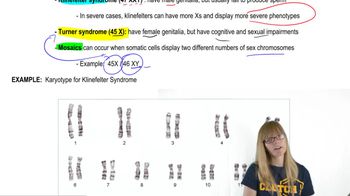
Turner syndrome arises when a female has only one X chromosome (45,X) due to the absence of a sex chromosome. This can result if a female gamete lacking an X chromosome (from nondisjunction) is fertilized by a normal X-bearing sperm, producing offspring with monosomy X and characteristic developmental features.
Recommended video:
Guided course
Human Sex Chromosomes
Related Videos
Related Practice
Textbook Question
What evidence indicates that humans with aneuploid karyotypes occur at conception but are usually inviable?
526
views