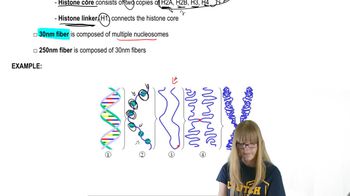
Contrast the chromatin fiber with the mitotic chromosome. How are the two structures related?
Table of contents
- 1. Introduction to Genetics51m
- 2. Mendel's Laws of Inheritance3h 37m
- 3. Extensions to Mendelian Inheritance2h 41m
- 4. Genetic Mapping and Linkage2h 28m
- 5. Genetics of Bacteria and Viruses1h 21m
- 6. Chromosomal Variation1h 48m
- 7. DNA and Chromosome Structure56m
- 8. DNA Replication1h 10m
- 9. Mitosis and Meiosis1h 34m
- 10. Transcription1h 0m
- 11. Translation58m
- 12. Gene Regulation in Prokaryotes1h 19m
- 13. Gene Regulation in Eukaryotes44m
- 14. Genetic Control of Development44m
- 15. Genomes and Genomics1h 50m
- 16. Transposable Elements47m
- 17. Mutation, Repair, and Recombination1h 6m
- 18. Molecular Genetic Tools19m
- 19. Cancer Genetics29m
- 20. Quantitative Genetics1h 26m
- 21. Population Genetics50m
- 22. Evolutionary Genetics29m
9. Mitosis and Meiosis
Mitosis
Problem 26
Textbook Question
Consider a diploid cell that contains three pairs of chromosomes designated AA, BB, and CC. Each pair contains a maternal and a paternal member (e.g., Am and Ap). Using these designations, demonstrate your understanding of mitosis and meiosis by drawing chromatid combinations as requested. Be sure to indicate when chromatids are paired as a result of replication and/or synapsis.
During meiosis I, assuming no crossing over, what chromatid combination(s) will be present at the completion of prophase I? Draw all possible alignments of chromatids as migration begins during early anaphase.
Verified step by step guidance1
Begin by understanding the chromosome composition: the diploid cell has three pairs of chromosomes (AA, BB, CC), each with a maternal (e.g., A^{m}) and paternal (e.g., A^{p}) homolog. Before meiosis I, each chromosome replicates, so each consists of two sister chromatids joined at the centromere.
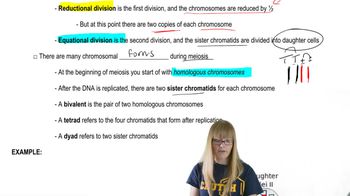
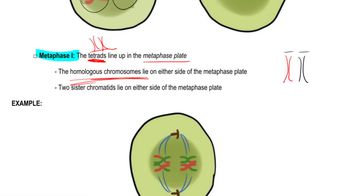
At the completion of prophase I, homologous chromosomes undergo synapsis, pairing tightly to form bivalents (tetrads). Each bivalent consists of four chromatids: two sister chromatids from the maternal chromosome and two sister chromatids from the paternal chromosome. Since no crossing over occurs, the chromatids remain unchanged in their original configuration.
For each chromosome pair (AA, BB, CC), represent the bivalent as two homologous chromosomes paired side-by-side, each with two sister chromatids. For example, the A bivalent will have A^{m} chromatids paired with A^{p} chromatids, each consisting of two sister chromatids (A^{m}_1 and A^{m}_2, A^{p}_1 and A^{p}_2).
As early anaphase I begins, homologous chromosomes separate and migrate to opposite poles. The key point is that sister chromatids remain attached; thus, each migrating unit is a chromosome with two sister chromatids. Draw all possible alignments showing that for each chromosome pair, either the maternal or paternal homolog can move to a given pole, reflecting independent assortment.
Summarize that at the end of prophase I, the cell contains three bivalents (each with four chromatids), and during early anaphase I, homologous chromosomes separate but sister chromatids stay together, resulting in chromatids aligned as pairs moving toward opposite poles without recombination.
Verified video answer for a similar problem:This video solution was recommended by our tutors as helpful for the problem above
Video duration:
2mPlay a video:
Was this helpful?
Key Concepts
Here are the essential concepts you must grasp in order to answer the question correctly.
Chromosome Structure and Replication
Chromosomes consist of two sister chromatids joined at a centromere after DNA replication during the S phase. Each chromatid is an identical copy, and together they form a replicated chromosome. Understanding this structure is essential to track chromatids through cell division stages like mitosis and meiosis.
Recommended video:
Guided course
Chromosome Structure
Synapsis and Homologous Chromosome Pairing in Meiosis I
During prophase I of meiosis, homologous chromosomes (maternal and paternal pairs) undergo synapsis, pairing tightly along their lengths to form tetrads. This pairing allows for alignment and potential crossing over, though in this question crossing over is excluded. Synapsis is key to understanding chromatid arrangements at this stage.
Recommended video:
Guided course
Meiosis Overview
Chromatid Segregation During Meiosis I Anaphase
In meiosis I, homologous chromosomes (each with two sister chromatids) separate and migrate to opposite poles, but sister chromatids remain attached. This reductional division halves the chromosome number. Recognizing that chromatids stay paired until meiosis II clarifies the chromatid combinations present during early anaphase I.
Recommended video:
Guided course
Meiosis Steps
Related Videos
Related Practice
Textbook Question
636
views
